
Image source: AFP
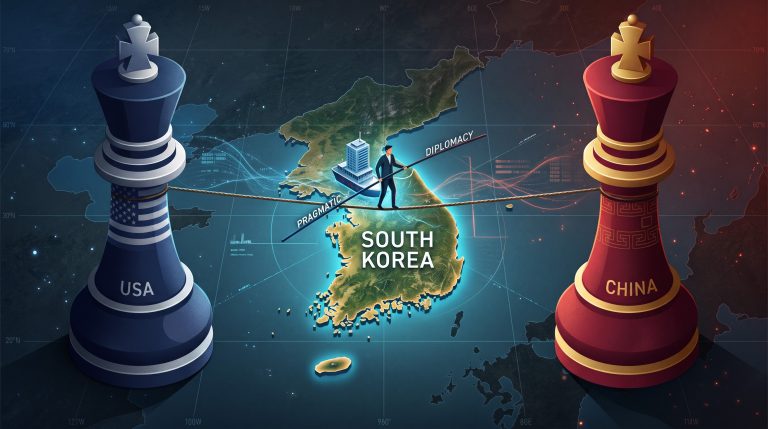
The foreign policy challenge faced by South Korea is a tough decision between its security partner, the United States, and its biggest regional trade collaborator, China.. Although this situation reflects real political and economic pressures, it does not mean that South Korea has no room to make its own decisions. South Korea relies on its partnership with the United States to address the dangers by North Korea, while also maintaining a good term with China for commerce, diplomatic efforts, and the stability of the region. (Keum, 2026). This paper argues that Seoul should maintain a strong alliance with the United States while applying selective strategic hedging. This means cooperating with Washington on important security issues, reducing economic dependence that could make South Korea vulnerable to pressure, and developing stronger partnerships with other countries. This approach is more realistic than simply following the United States in every dispute with China or trying to maintain an equal position between the two powers.
This issue is important because the Korean Peninsula faces several security challenges at the same time. Missile development and nuclear weapons of North Korea create a direct threat to South Korea while the rivalry between the United States and China increasingly affects regional security, technology, supply chains, and maritime activities (Hwang, 2024). South Korea also has an export-based economy that depends on access to international markets. As a result, decisions made to strengthen national security can also create economic and diplomatic problems. One example is in 2016 until 2017 where there’s a deployment of the THAAD System (U.S. Terminal High Altitude Area Defense). China resisted the framework of the system, due to its security reasons, while South Korean businesses and the tourism sector faced economic pressure during the dispute (Rostineu & Ali). Research on China’s response shows that Beijing used various economic and political measures to put pressure on South Korea (Harrel, Rosenberg, & Saravalle , 2018). Although not every economic loss was necessarily planned by the Chinese government, this case shows how economic relations can become a source of pressure. It also explains why South Korea needs to reduce its dependence on a single economic partner.
The concept of hedging can help explain this foreign policy approach. When facing uncertainty in international relations, a state can maintain cooperation with another power while also preparing for possible risks that may come from that same power. At the same time, it can maintain security relations with a different state (Katzenstein & Seybert, 2017). Hedging is different from balancing, which focuses more directly on responding to a perceived threat, and bandwagoning, which involves supporting a stronger power to gain political or economic benefits. (Cheng-Chwee, 2008) explains that hedging allows states to maintain several policy options when the future direction of international relations is uncertain. However, in South Korea’s case, hedging does not mean staying neutral. North Korea poses a direct military danger to South Korea, which already has a security relationship with the United States. Therefore, its hedging strategy has clear limits. Its security is still primarily based on the U.S. alliance, while economic diversification and regional cooperation help South Korea maintain flexibility in its foreign policy.
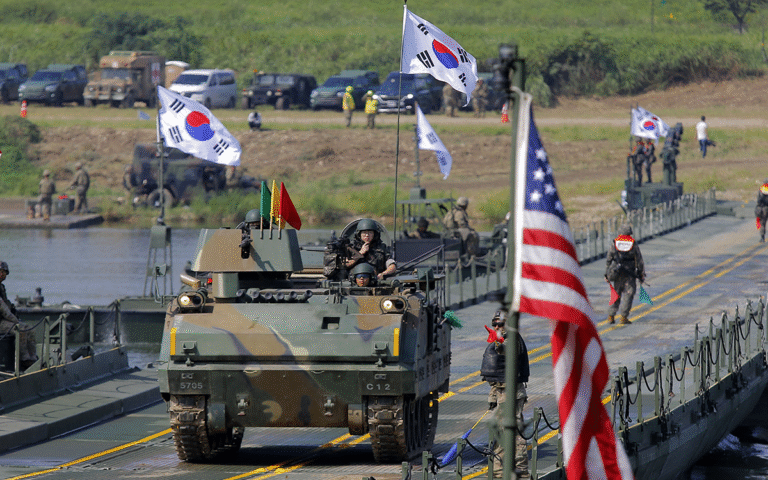
The U.S. alliance remains crucial for providing extended deterrence and strengthening mutual defense efforts. In 2023, the Washington Declaration established the Nuclear Consultative Group and strengthened consultation between the two governments on nuclear deterrence. This agreement was introduced partly in response to South Korea’s concerns about whether the United States would provide protection if the country faced a nuclear threat (Bingen, 2023) This cooperation can increase South Korea’s confidence in the U.S. security commitment and improve coordination between the two countries. However, maintaining public trust in the alliance also requires continuous effort. South Korean leaders need to explain the purpose and limits of nuclear consultation and continue improving their own military capabilities. The Nuclear Non-Proliferation Treaty is also reaffirmed as a commitment for South Korea in the declaration. This shows that South Korea and the United States can strengthen its defense cooperation without developing its own nuclear weapons (Snyder, 2023).
Besides security cooperation, hedging also needs to focus on economic and diplomatic relations. Indo-Pacific Strategy 2022 of South Korea highlights the importance of supply-chain security, economic cooperation, and stronger partnerships with countries across the region (Korea, 2022). These goals are important if South Korea wants to reduce its economic dependence on China. However, this effort should focus on expanding economic partnerships rather than creating a group of countries against China. South Korea can strengthen trade and technology cooperation with Southeast Asian countries, Europe, India, and other partners. By doing so, it can reduce the risks of depending too much on one market or supplier. At the same time, Seoul should continue maintaining dialogue with Beijing on issues such as trade, climate change, public health, and North Korea. Maintaining communication with China does not mean that South Korea must accept China’s objections to its defense policies. Instead, diplomatic engagement can help prevent misunderstandings and reduce the possibility of further conflict.
However, this strategy also faces several challenges. First, China may see stronger security cooperation between Japan, South Korea, and the United States as an attempt to limit its influence in the region. However, the United States might view South Korea’s choice to limit cooperation as a lack of full support. Second, reducing economic dependence on China will take time. South Korean companies cannot easily replace major markets or suppliers without facing additional costs. Third, domestic politics can also affect more of South Korea’s foreign policy constitency. (Kim, 2021) says that South Korea’s security policy is influenced not only by international pressures but also by differences in political views between domestic political groups. As a result, changes in government can lead to changes the relations managing way of South Korea with the United States and China. This lack of consistency can weaken South Korea’s position and make both countries uncertain about its foreign policy direction.
To deal with these challenges, South Korea needs to establish clear foreign policy principles that remain consistent even when its government changes. These principles should include maintaining national defense through the U.S. alliance, making independent security decisions, opposing the use of economic pressure to influence its decisions, and keeping diplomatic and economic relations open whenever possible. The government should also involve the parliament, business sector, and public in important foreign policy discussions. This can help create stronger domestic support and make its foreign policy more consistent. In addition, South Korea needs to separate issues that directly affect its national security from issues that may only create unnecessary political tension with Washington or Beijing. By doing so, Seoul can avoid turning every disagreement between the two country into a situation where it must choose one side.
South Korea cannot completely avoid the rivalry between the United States and China, nor should it expect to remain outside this rivalry. The most realistic approach is to adopt a measured hedging strategy built on a firm U.S. alliance, greater economic self-reliance, and proactive regional diplomacy. This approach recognizes that South Korea faces an immediate military threat from North Korea while also dealing with the wider challenges of great-power competition. It allows South Korea to maintain its security without making every relationship with other countries a competition between two opposing sides. For Seoul, strategic autonomy does not mean becoming independent from its international partners. Instead, it means having the ability to make its own foreign policy decisions without allowing any single country to control all aspects of its international relations.
Writer: MOH ASY’ARI – 202110360311317
References
Bingen, K. (2023). Relevance of Nuclear Deterrence in this Modern Era. Ronald Reagan Institute.
Cheng-Chwee, K. (2008). The Essence of Hedging: Malaysia and Singapore’s Response to a Rising China. Contemporary Southeast Asia.
Harrel, P., Rosenberg, E., & Saravalle , E. (2018, June 11). China’s Use of Coercive Economic Measures.
Hwang, J. (2024, March). The New Security Challenges on the Korean Peninsula. Retrieved from https://www.globalasia.org/v19no1/feature/the-new-security-challenges-on-the-korean-peninsula_jihwan-hwang
Katzenstein, P., & Seybert, L. (2017). 2 – Uncertainty, Risk, Power and the Limits of International Relations Theory. In Protean Power – Exploring the Uncertain and Unexpected in World Politics. Cambridge University Press.
Keum, P. D. (2026). South Korea’s Strategic Choices between China and America.
Kim, M.-h. (2021). Hedging between the United States and China? South Korea’s ideology-driven behavior and its implications for national security. International Relations of the Asia-Pacific .
Korea, M. o. (2022). Strategy for a Free, Peaceful, and Prosperous Indo-Pacific Region.
Rostineu, R., & Ali, S. R. (n.d.).
Seong Hyeon Choi. (2025, October 9). Retrieved from Eagle Intel Reports: https://eagleintelreports.com/seouls-strategic-recalibration-between-the-us-and-china
Snyder, S. (2023, April 27). The Washington Declaration: Expanding the Nuclear Dimension of the U.S.-South Korean Alliance Response. Retrieved from https://www.cfr.org/articles/washington-declaration-expanding-nuclear-dimension-us-south-korean-alliance-response