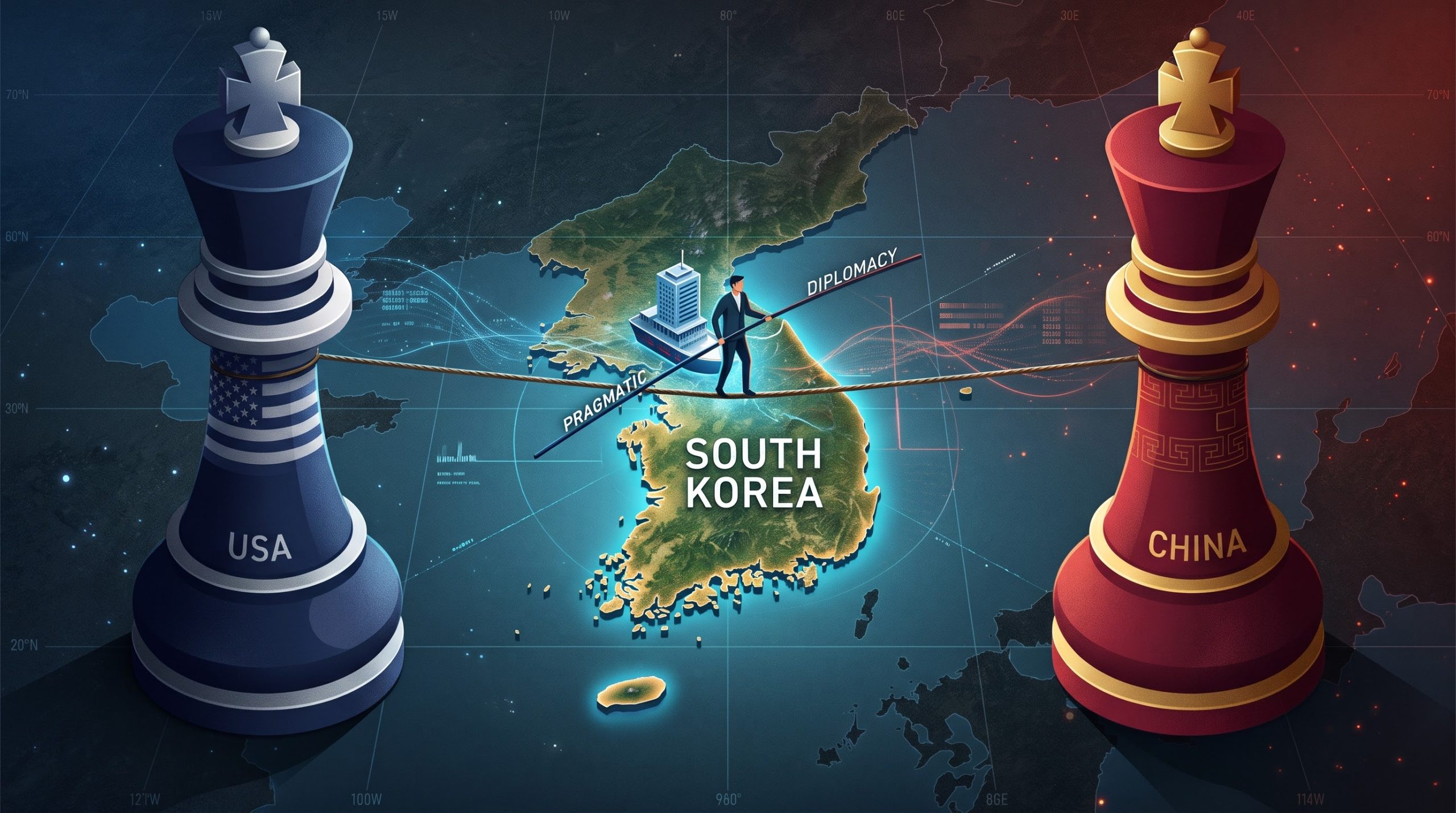

Image source: AI Generate
Since taking office in June 2025, President Lee Jae-myung has steered South Korea toward a foreign policy line his government calls pragmatic diplomacy, which places national interest above ideological alignment (Yoda, 2026). Rather than choosing between Washington and Beijing, Seoul has tried to keep the United States alliance as its security anchor while repairing ties with China, stabilizing relations with Japan, and reopening channels toward North Korea (East Asia Forum Editorial Board, 2026). This essay summarizes that strategy, explains why it matters, offers my assessment, and analyzes the issue through three international relations concepts: hedging, balance of threat, and the alliance security dilemma.
The strategy’s clearest test came in January 2026. Lee made a state visit to China from January 4 to 7, the first by a South Korean president in six years, hoping to restore relations strained since Seoul deployed the THAAD missile defense system (Ramage & Kim, 2026). The summit produced a commitment to conclude free trade negotiations and fifteen cooperation agreements, yet Xi Jinping offered no explicit support for North Korean denuclearization, and Korean cultural exports stayed blocked (Ramage & Kim, 2026). Days later, Lee met Prime Minister Sanae Takaichi in Nara, where the two leaders discussed South Korea’s bid to join the CPTPP trade bloc and agreed to test the remains of Korean laborers killed in a 1942 mining accident (Ramage & Kim, 2026). By August, the approach had widened into economic outreach, including a trip to South America aimed at exports and supply chains (Yoda, 2026).
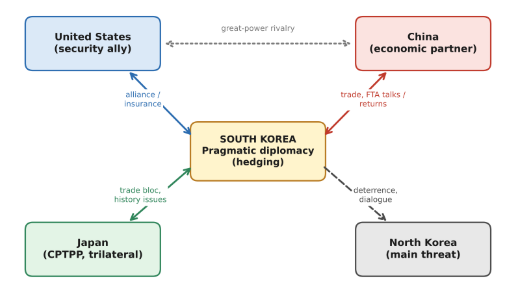
South Korea’s Hedging Position between Competing Powers
Note. Conceptual illustration created by the author based on Kuik (2008), Ramage and Kim (2026), and East Asia Forum Editorial Board (2026).
Why the Issue Matters
This issue matters for three reasons. First, the Korean Peninsula is a flashpoint where American, Chinese, Japanese, and Russian interests converge, so Seoul’s alignment choices influence regional stability. Second, Lee governs under American tariff pressure from the second Trump administration, which makes trade negotiations as consequential as military planning (East Asia Forum Editorial Board, 2026). Third, the case tests a broader question for middle powers: can they avoid forced choices as great-power rivalry intensifies? Analysts observe that both China and Japan are trying to draw South Korea closer to their respective orbits (Ramage & Kim, 2026), which raises the cost of any misjudgment.
Analysis: Hedging, Balance of Threat, and the Alliance Dilemma
Hedging offers the clearest lens. Kuik (2008) describes hedging as insurance-seeking behavior in which a state refuses to commit fully to either balancing or bandwagoning, instead combining returns-maximizing policies with risk-contingency policies. Although Kuik built the concept from Southeast Asian cases, it fits Seoul well. Trade talks with China and the CPTPP bid maximize returns, while the American alliance and trilateral cooperation with Japan provide insurance. Commentators describe the same pattern, noting a careful hedge between the United States and China (East Asia Forum Editorial Board, 2026) and experts who identify pragmatism as the driver of Lee’s balancing among Washington, Beijing, and Tokyo (Yonhap, 2026).
Walt’s (1987) balance-of-threat theory explains why hedging does not mean neutrality. Walt argues that states align against the party they perceive as most threatening, a judgment shaped by aggregate power, geographic proximity, offensive capability, and aggressive intentions. For Seoul, the nuclear-armed North remains the most proximate and acute danger, which keeps the American alliance essential even as relations with Beijing improve. The Beijing summit illustrates the limit: Xi’s silence on denuclearization shows China cannot yet serve as a security partner on Seoul’s central problem (Ramage & Kim, 2026). A neorealist reading (Waltz, 1979) reaches a similar conclusion: in an anarchic system, a middle power prioritizes survival, and hedging lets Seoul pursue survival without paying the price of full commitment to one camp.
Snyder’s (1984) alliance security dilemma adds a third layer. Allies fear abandonment when a partner’s support seems uncertain, and entrapment when they might be dragged into a partner’s conflicts. Facing tariff pressure and shifting American priorities, Seoul has reason to fear abandonment, which encourages diversification; yet warmer ties with China risk provoking suspicion in Washington. Beijing, for its part, is expected to discourage Seoul from joining American technology containment efforts and to exploit any wedge in the alliance (Ernst, 2025). Critics have therefore portrayed the policy as tilting toward China, although former American ambassadors to Seoul describe it as closer to rebalancing than a pro-China turn (“Former U.S. Ambassadors to South Korea,” 2026).
My Assessment
In my view, pragmatic diplomacy is the most rational option available to Seoul, but it is more fragile than its supporters admit. Its strength lies in reducing dependence on any single partner. Diversifying toward Japan and CPTPP members (Ramage & Kim, 2026) and toward Latin America (Yoda, 2026) lowers Seoul’s exposure to the kind of economic coercion it suffered after THAAD (Ramage & Kim, 2026). Its weakness is that hedging depends on credibility. If Washington reads engagement with Beijing as disloyalty, or Beijing reads the alliance as containment, Seoul could lose trust on both sides, ending up with neither security nor market access.
To make hedging sustainable, I would recommend three steps. First, Seoul should keep its alliance commitments predictable and consult Washington before concluding major agreements with China. Second, it should anchor economic diversification in multilateral frameworks such as the CPTPP, which are harder to weaponize than bilateral deals. Third, it should describe its policy publicly as rebalancing rather than equidistance, because language shapes how both capitals interpret Seoul’s intentions.
Conclusion
South Korea’s pragmatic diplomacy shows that a middle power can gain room to maneuver without abandoning its alliance. Hedging, balance-of-threat logic, and the alliance dilemma together explain both why the strategy is attractive and why it is risky. Its success will depend less on grand declarations than on whether Seoul can convince both Washington and Beijing that its flexibility is a source of stability, not a prelude to defection.
Writer: Ibnu Afifudin – 202510360110062
References
East Asia Forum Editorial Board. (2026). South Korea’s Lee Jae-myung deftly navigates domestic and diplomatic minefields. East Asia Forum. https://eastasiaforum.org/?p=2348952
Ernst, M. (2025, June 6). The election of President Lee Jae-myung and China. Centre for Security, Diplomacy and Strategy. https://csds.vub.be/publication/the-election-of-president-lee-jae-myung-and-china/
Former U.S. ambassadors to South Korea: “Lee Jae-myung administration is not anti-American… fully understands the value of the alliance.” (2026, June 5). Asia Economy. https://view.asiae.co.kr/en/article/2026060506272910012
Kuik, C.-C. (2008). The essence of hedging: Malaysia and Singapore’s response to a rising China. Contemporary Southeast Asia, 30(2), 159–185. https://doi.org/10.1355/CS30-2B
Ramage, T., & Kim, E. (2026, January 27). Lee Jae Myung tests South Korea’s pragmatic diplomacy between China and Japan. Korea Economic Institute of America. https://keia.org/analysis/lee-jae-myung-tests-south-koreas-pragmatic-diplomacy-between-china-and-japan/
Snyder, G. H. (1984). The security dilemma in alliance politics. World Politics, 36(4), 461–495. https://doi.org/10.2307/2010183
Walt, S. M. (1987). The origins of alliances. Cornell University Press.
Waltz, K. N. (1979). Theory of international politics. McGraw-Hill.
Yoda, K. (2026, August 17). South Korea President Lee promotes ‘K-culture’, weapons, to accelerate ‘pragmatic diplomacy’. The Yomiuri Shimbun. https://asianews.network/?p=294840
Yonhap. (2026, January 24). Pragmatism drives Lee’s diplomacy amid complex regional ties: Experts. The Korea Times. https://www.koreatimes.co.kr/foreignaffairs/20260124/pragmatism-drives-lees-diplomacy-amid-complex-regional-ties-experts