
Image source: Pinterest
South Korea is known as a developed country whose economy heavily depends on exports. However, South Korea is currently facing a serious demographic problem. In 2023, the birth rate in South Korea was only 0.72 children per woman, making it the lowest in the world. In addition, South Korea’s population has started to decline since 2021 (OECD, 2024). This situation has led to a decrease in the workforce, especially in small and medium-sized manufacturing industries. Therefore, migrant workers have become an important part of the workforce that supports South Korea’s economy. Unfortunately, the demand for migrant workers has not been matched by adequate protection and fair treatment. In this essay, I will discuss the various problems faced by migrant workers in South Korea, why this issue is important for South Korea’s image and commitment to human rights, and analyze it using international relations concepts. In my opinion, South Korea needs migrant workers to support its economy, but it still does not fully consider them as part of its society.
South Korea recruits low-skilled foreign workers through the Employment Permit System (EPS), which was introduced in 2004. Through this system, South Korea brings in workers from 16 partner countries using E-9 visas to work in companies with fewer than 300 employees (OECD, 2024). This is because many small and medium-sized enterprises have difficulty finding local workers. In fact, 90.6% of the surveyed SMEs stated that they employed foreign workers because they could not find workers from the local population (KBIZ, 2023, as cited in OECD, 2024). The number of foreign workers accepted has also continued to increase, from around 50,000–60,000 workers per year to approximately 160,000 in 2024 (OECD, 2024). Indonesian workers themselves accounted for around 11.2% of the total EPS workers in December 2022.
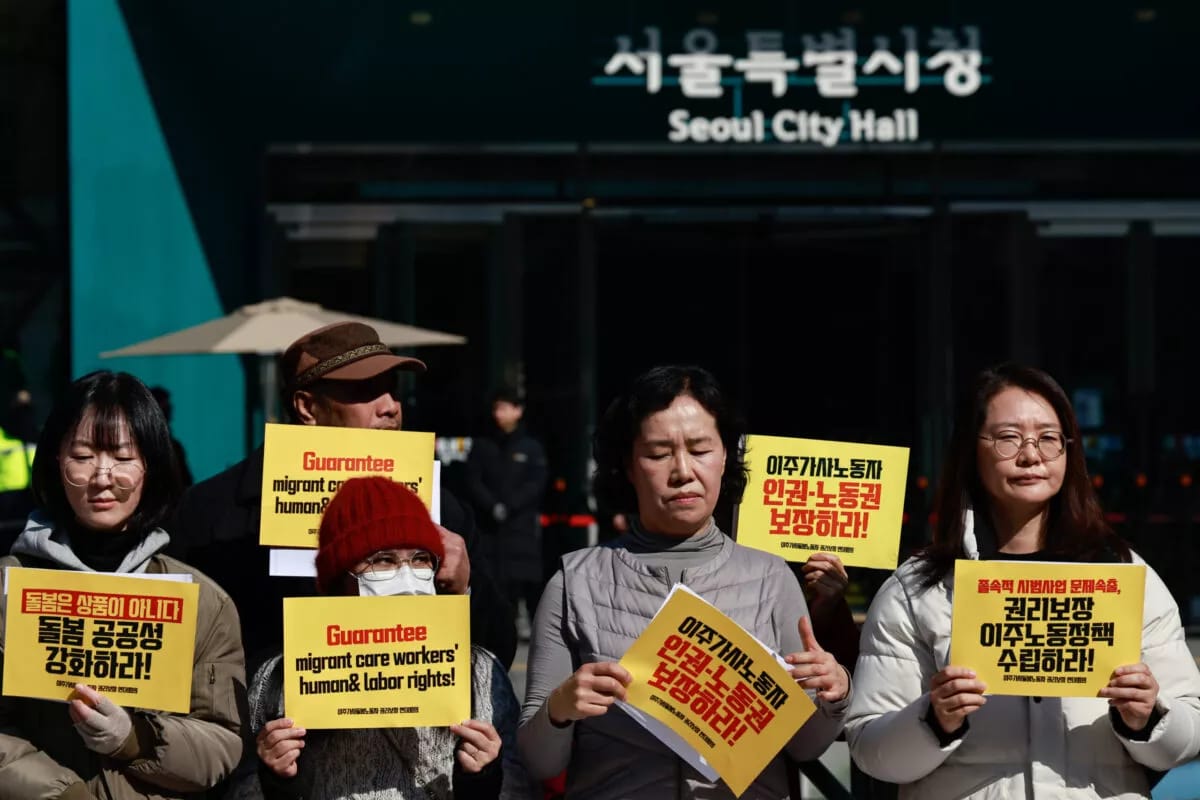
Although the EPS has successfully reduced the proportion of undocumented workers from 51% in 2003 to 19.6% in 2022, the system still has several problems. According to OECD (2024), one of the problems is that migrant workers remain tied to their original employers and can only change workplaces with their employers’ permission, unless there is a violation of the employment contract. This situation puts migrant workers in a weak bargaining position and makes them vulnerable to exploitation by employers, including regarding working and living conditions. Furthermore, more than 35% of foreign-born residents live in overcrowded housing, while more than 60% of migrant workers in the agricultural and fishing sectors live in inadequate accommodation, such as containers. Migrant workers are also not allowed to bring their families and can only stay in South Korea for around four years and ten months.
This issue can be analyzed using the concept of stigma management. Adler-Nissen (2014) explains that countries can receive negative labels when their actions are considered different from international standards. Countries then try to manage these negative perceptions. According to Link and Phelan, stigma involves labeling, stereotyping, separation, status loss, and discrimination.
Labelling. Lee et al. (2026) explain that EPS workers have limited freedom to change jobs and may lose their residence status if they move without their employers’ permission. This policy is criticized because it may lead to forced labor practices according to ILO standards. In addition, migrant workers face higher workplace risks, with injury and death rates estimated to be two to three times higher than those of Korean workers (Lee et al., 2026).
Separation. OECD (2024) reports that more than 35% of foreign-born residents live in overcrowded housing. Lee and Rudolf (2024) also found that immigrants from Western English-speaking countries earn more than Asian immigrants. These conditions show differences in treatment and social separation between immigrant groups.
Status loss and response. Adler-Nissen (2014) explains that stigma becomes more serious when it leads to status loss and discrimination. South Korea’s multiculturalism policy can be seen as an effort to improve its image in international society. However, in 2023, the government restricted migrant workers from changing jobs outside their regional areas (OECD, 2024). In my opinion, recognizing stigma is not enough; South Korea must also make real changes to protect migrant workers’ rights.
In my opinion, the South Korean government’s efforts are still not enough to protect migrant workers. Indeed, the number of undocumented workers successfully decreased from 51% in 2003 to 19.6% in 2022. The EPS also regulates that foreign workers must receive equal treatment to local workers. However, in reality, migrant workers still experience workplace accidents more frequently, and some are even scolded when they complain about being sick. In addition, many of them still live in inadequate housing. The government may consider restrictions on changing jobs necessary to protect local workers and meet labor demands. However, in my opinion, this should not come at the expense of foreign workers’ rights. They should be given more freedom to change jobs so they can report violations without being afraid of losing their jobs. Therefore, South Korea needs to improve its labor regulations and strengthen workplace safety protection for migrant workers, especially in small companies.
Based on the discussion above, it can be concluded that migrant workers play an important role in supporting South Korea’s economy, especially because the country is facing a decline in population and workforce. However, this important role has not been followed by adequate protection of their rights. Through the concept of stigma management, it can be seen that policies and treatment toward migrant workers can affect South Korea’s image in the eyes of international society. In my opinion, it is not enough for South Korea to simply show its commitment to multiculturalism and equality; it must also prove this commitment through real policies. Migrant workers should not only be seen as workers who are needed, but also as part of society who have the right to receive fair treatment and equal protection.
Writer: Jasmine Nahdliya Mecca – 202510360110018
References
Adler-Nissen, R. (2014). Stigma management in international relations: Transgressive identities, norms, and order in international society. International Organization, 68(1), 143–176. https://doi.org/10.1017/S0020818313000337
Lee, H., Kang, M.-J., & Kim, S.-S. (2026). Occupational injuries and illnesses under the Employment Permit System: Exploring perceptions and responses of migrant workers in South Korea. Journal of Immigrant and Minority Health. https://doi.org/10.1007/s10903-026-01997-7
Lee, M., & Rudolf, R. (2024). Gender, race, and migrant worker wage inequality in South Korea. OMNES: The Journal of Multicultural Society, 14(1), 1–47. https://doi.org/10.14431/omnes.2024.01.14.1.01
OECD. (2024). OECD economic surveys: Korea 2024. OECD Publishing. https://doi.org/10.1787/c243e16a-en