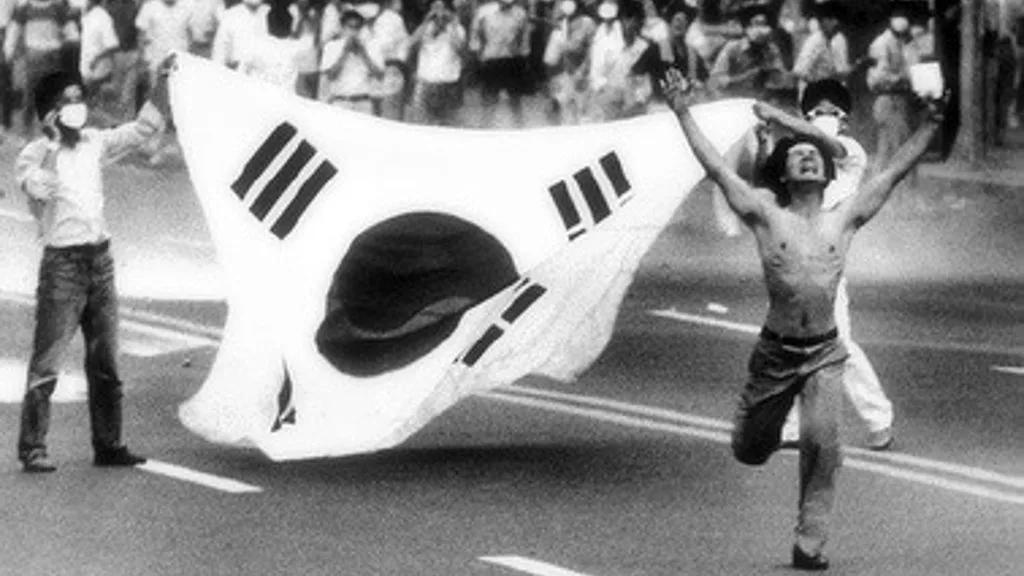

Image source: Kyo Myung-Jin, former photographer at Hankook Ilbo, a sister paper for The Korea Times. / Courtesy of the National Museum of Korean Contemporary History
During the Cold War, South Korea was in a very tense and unstable situation, with internal political instability and the constant threat of North Korea. This period was not only about external conflict but about the state’s internal response to it. National security grew to be one of the most important priorities for the government affecting political decisions as well as everyday life. In many cases the line between protecting the nation and controlling the population became increasingly difficult to distinguish. Under the authoritarian leadership of Chun Doo hwan, security was often portrayed as urgent and necessary, which allows the justification of strict policies and the limitation of civil liberties (Kraft, 2006). Individual rights were often sacrificed for the sake of stability. Security can be understood not only as a response to external threats, but also as a powerful political instrument used to maintain authority and shape public perception (Jung, 2017).
In the 1980s, South Korea was under an authoritarian regime, where political power was highly centralized. Anti communism was a big deal back then and any indication of an association with North Korea was often seen as a serious threat to national security. This created an atmosphere where the government could rationalise tight control over society under the disguise of stability. The state was more inclined to employ policies such as surveillance, censorship and the suppression of political opposition, to remove anything it saw as a potential threat. This suggests that the government’s focus on security was closely tied to its effort to maintain control over both political space and public behavior.
The impacts were strongly felt in everyday life, and especially by ordinary citizens. People began to live in an atmosphere full of suspicion and uncertainty, and it became part of daily life. people watched what they said, avoided certain books, and thought twice before gathering in public spaces. Neighbors could report one another to the regimes for suspected association with North Korea. Student organizations were routinely monitored without any clear reason. Public space became strict, people preferred to stay silent and avoid political involvement. Families were affected too, parents often restricted their children from engaging in suspicious social activities, for the safety of the family. It wasn’t the threat from North Korea that was felt most in daily life, but the fear of the regimes themselves. People began to wonder whether the state’s focus on security was truly for protection or more about maintaining control (Human Rights Watch, 2015).
Over time, the public became increasingly resistant to the government’s heavy reliance on security narratives. The Gwangju Uprising had already made that tension impossible to ignore. The demonstrations began as student protests calling for political reform, but went into violence as the government cracked down militarily and claimed the protests were a threat to national security (Britannica, 2014). This violent suppression caused significant loss of life and left a deep sense of injustice among the public. Rather than silencing opposition, Gwangju became a powerful symbol of state repression, shaping public memory and increasing awareness of the limits of authoritarian rule.
Throughout the 1980s, the memory of Gwangju continued to influence public attitudes, contributing to a broader sense of frustration that spread across different layers of society (Origins, 2025). Students, workers, and the middle class gradually became more willing to challenge the government. That tension finally reached its breaking point with the June Democratic Uprising of 1987. The immediate trigger was the death of a university student who was tortured during a police interrogation, which intensified public outrage and mobilized people across the country(Gwangju News, 2025). Large scale demonstrations spread rapidly in major cities, people called for democratic reforms, such as direct presidential elections and increased political openness (Korea Herald, 2023).
The 1987 protests were better organized, more widespread and less easily suppressed than earlier movements. The participation of various social groups has demonstrated that the demand for change was no longer limited to a small group of activists, but has become a national movement (Paik, 2007). The government was eventually forced to respond by introducing significant political reforms, marking the beginning of South Korea’s transition toward a more democratic system. Both the events of 1980 and 1987 are examples of the failure of security as an instrument of power to sustain long term control. Instead, it intensified public resistance and led to demands for a political system that prioritized accountability and individual rights.
South Korea’s experience during the Cold War shows that the concept of security is not always neutral. It is important to understand this issue because it shows how security can be used not only for protection but also to justify control, especially under an authoritarian leadership. In this case, the increased emphasis on security impacted politics and everyday life, often at the cost of individual freedoms. However, the resistance that led to the June Democratic Uprising proved this approach unsustainable.
security itself is necessary, especially in a tense situation like the Cold War. However, when it is used to justify too much control and the restriction of basic rights, it becomes a problem. The case of South Korea shows that while security is important, it needs to be balanced with the protection of individual freedoms.
Writer: ALEXANDRA MAHADEWI CINTA MAKARIM – 202410360110100
References
Encyclopaedia Britannica. (2014, August 27). Gwangju Uprising. Britannica. https://www.britannica.com/event/Gwangju-Uprising
Gwangju News. (2025, June 5). The 1987 June Democratic Struggle: A pivotal moment that brought genuine democracy to Korea. https://gwangjunewsgic.com/features/the-1987-june-democratic-struggle-a-pivotal-moment-that-brought-genuine-democracy-to-korea
Human Rights Watch. (2015, May 28). South Korea: Cold War relic law criminalizes criticism. https://www.hrw.org/news/2015/05/28/south-korea-cold-war-relic-law-criminalizes-criticism
Jang, S. Y. (n.d.). The Gwangju uprising: A battle over South Korea’s history. Wilson Center. https://www.wilsoncenter.org/blog-post/the-gwangju-uprising-battle-over-south-koreas-history
Jung, B. (2017). The trajectory of anti-communism in South Korea. Asian Journal of German and European Studies. https://link.springer.com/article/10.1186/s40856-017-0015-4
Korea Herald. (2023, May 24). June 1987: Democracy takes root, at least in the Constitution. https://www.koreaherald.com/article/3131387
Kraft, D. B. (2006). South Korea’s National Security Law: A tool of oppression in an insecure world. Wisconsin International Law Journal, 24(2), 627–659. https://uknowledge.uky.edu/cgi/viewcontent.cgi?article=1494&context=law_facpub
Origins. (2025). Gwangju isn’t over. Ohio State University. https://origins.osu.edu/read/gwangju-isnt-over
Paik, N. (2007). Democracy and peace in Korea twenty years after June 1987. Asia-Pacific Journal: Japan Focus. https://apjjf.org/nak-chung-paik/2440/article
Shin, G. W. (2022, September 15). Gi-Wook Shin on Gwangju and South Korea’s democracy. Freeman Spogli Institute for International Studies, Stanford University. https://fsi.stanford.edu/news/gi-wook-shin-gwangju-and-south-korea%E2%80%99s-democracy
UNESCO. (n.d.). Human rights documentary heritage 1980 – Archives for the May 18th Democratic Uprising against military regime, in Gwangju, Republic of Korea. https://www.unesco.org/en/memory-world/human-rights-documentary-heritage-1980-archives-may-18th-democratic-uprising-against-military-regime