
Image source: Scarbrough Global
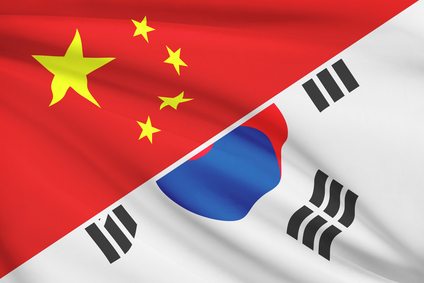
Economic relations between China and South Korea represent one of the clearest manifestations of complex interdependence in contemporary East Asia. Since the normalization of diplomatic relations in 1992, bilateral trade has expanded significantly, embedding both countries within dense regional production networks. However, this relationship is not purely cooperative; rather, it reflects a dynamic interplay between interdependence, competition, and strategic vulnerability.
Historically, Sino–South Korea trade evolved from limited exchanges into a highly dynamic partnership. Trade increased dramatically from approximately US$5 billion in 1992 to around US$186 billion in 2008, driven by structural complementarity: South Korea exported capital- and technology-intensive goods, while China provided labor-intensive manufacturing and served as a major export destination. This pattern positioned both countries within vertically integrated supply chains characteristic of East Asian production networks.
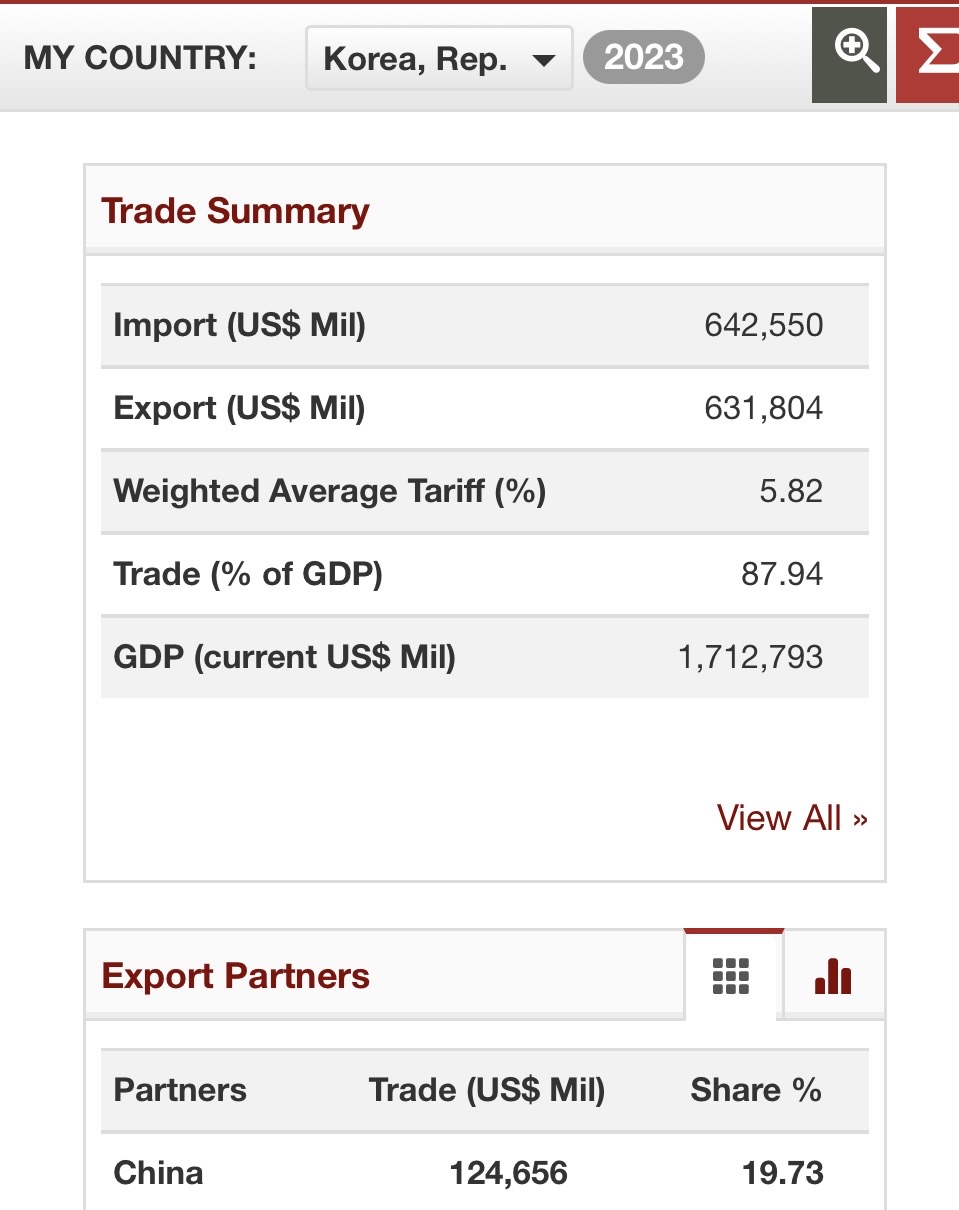
Image source: World Bank
In the contemporary period, this interdependence remains deeply entrenched and empirically measurable. Data from the World Bank indicates that China accounts for approximately 19.7% of South Korea’s total exports, making it the country’s largest trading partner, slightly above the United States. This high level of trade concentration demonstrates that South Korea’s economic performance is highly sensitive to fluctuations in Chinese demand. Moreover, such dependence generates structural vulnerability, as shifting export markets or restructuring supply chains would involve significant economic costs due to their deeply embedded nature. This condition exemplifies how interdependence can constrain policy flexibility in international relations.
Over time, however, this complementary structure has shifted toward increasing competition. China’s industrial upgrading has transformed it into a producer of higher value-added goods, directly challenging South Korea in sectors such as semiconductors, electronics, shipbuilding, and automobiles. As a result, bilateral trade increasingly reflects intra-industry competition rather than simple complementarity, indicating a structural transformation in the regional political economy.
From a theoretical perspective, this relationship can be analyzed using the framework of Complex Interdependence developed by Robert O. Keohane and Joseph S. Nye. They argue that global politics is characterized by multiple channels of interaction, the absence of a clear hierarchy among issues, and the declining centrality of military force in economic relations. Within this framework, power is not solely derived from military capabilities but also from asymmetric patterns of economic dependence.
A key analytical distinction in this framework is between sensitivity and vulnerability interdependence. South Korea’s reliance on the Chinese market makes it highly sensitive to economic changes in China, as demonstrated by its export concentration. At the same time, its vulnerability lies in the high adjustment costs associated with diversifying trade partners or relocating production networks. Conversely, China remains dependent on South Korean technological inputs, particularly in advanced semiconductor production, creating a relationship of mutual but asymmetric dependence.
The deployment of THAAD in 2016 provides a critical empirical case demonstrating how interdependence can be strategically leveraged. Following South Korea’s decision to deploy the system in response to North Korean threats, China imposed informal economic retaliation, including restrictions on tourism, regulatory pressure on Korean firms such as Lotte, and consumer boycotts. These measures illustrate how economic interdependence can be transformed into a tool of coercion.
This episode highlights the logic of asymmetric interdependence more clearly. China was able to exploit its position as South Korea’s primary economic partner to impose tangible costs without resorting to military force. In this sense, interdependence did not eliminate conflict; rather, it reshaped it into economic and regulatory forms of pressure. Economic relations thus became an instrument of strategic influence, reinforcing the argument that interdependence simultaneously generates cooperation and conflict.
In response, South Korea adopted a strategic compromise known as the “Three No’s Policy,” which included commitments to no additional THAAD deployments, no participation in a US-led missile defense system, and no trilateral military alliance with the United States and Japan. This policy reflects an attempt to reduce economic vulnerability while maintaining core security interests. It demonstrates how middle powers navigate structural constraints by balancing security imperatives with economic dependence.
At the regional level, institutional frameworks such as the Regional Comprehensive Economic Partnership further reinforce interdependence by promoting trade liberalization and supply chain integration. Both China and South Korea benefit from these arrangements, which help stabilize economic relations despite underlying political tensions. This suggests that regional institutions play a stabilizing role even when bilateral relations experience friction.
Conclusion
The China–South Korea trade relationship highlights the complexity of contemporary international political economy. It is defined not only by deep economic integration but also by structural asymmetry, strategic competition, and vulnerability. Through the lens of complex interdependence, it becomes evident that economic ties do not eliminate conflict; rather, they transform it into subtler forms such as economic coercion and regulatory pressure.
The THAAD episode further demonstrates that interdependence can be instrumentalized as a source of power within asymmetric relationships. For middle powers like South Korea, this creates a persistent strategic dilemma: how to maintain security commitments while managing economic dependence. Understanding this dynamic is essential for analyzing East Asian regional order and the evolving structure of global supply chains.
Writer: Ayu Shinta Dewi – 202410360110088
References:
Keohane, R. O., & Nye, J. S. (2012). Power and interdependence (4th ed.). Longman.
Liani, J. N., Rezasayah, T., & Heryadi, R. D. (2025). Dynamics of South Korea’s Three No’s policy: THAAD deployment and China relations analysis. Jiomata International Journal of Social Science.
World Bank. (2024). World Integrated Trade Solution (WITS). https://wits.worldbank.org/
Zhou, S. (2010). Sino–South Korean trade relations: From boom to structural transformation. East Asian Institute, National University of Singapore. https://research.nus.edu.sg/eai/wp-content/uploads/2017/11/BB508.pdf
Global Times. (2025, December). Trade data on China–South Korea relations. https://www.globaltimes.cn/page/202512/1350068.shtmla