
Image source: Reuters
South Korean security debates usually focus on North Korea’s missiles and nuclear weapons. A slower force is eroding the foundations of national defense: demographic decline. This essay examines how ultra-low fertility affects military manpower, national power, and the country’s position in its alliance with the United States. The issue matters because deterrence on the peninsula still relies on conscripted soldiers and a strong economy, and both depend on population. I argue that demographic decline should be treated as a core security issue, and that technology and recruitment reform can soften the problem without solving it.
The Issue
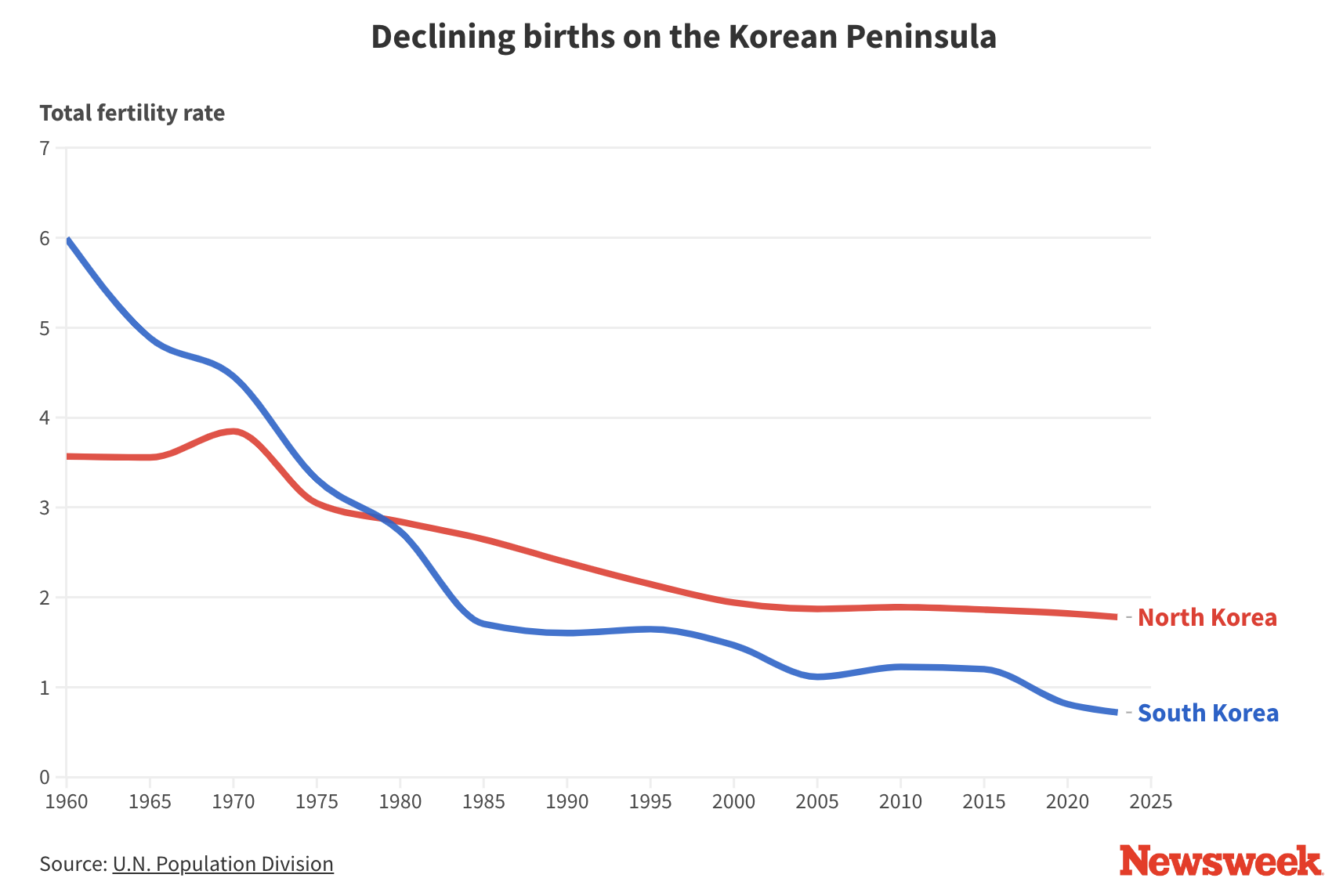
South Korea has the world’s lowest birthrate. Its total fertility rate was 0.80 in 2025, up from 0.75 in 2024, and the population of 51.8 million is projected to shrink by almost a third to 36.2 million by 2072 (Lee, 2026). The recent rebound is real: births rose 6.7 percent in 2025, the highest since 2021 (Yonhap, 2026). But the rebound starts from a very low base.
The military effects are already visible. Korea struggles to maintain a target standing force of 500,000, and the figure fell to around 450,000 by 2025, two years earlier than a 2023 government-linked projection had expected (The Korea Times, 2026). The same analysis notes that troop strength could fall below 400,000 in 2038 if the system does not change. A separate study warns that the force could shrink to roughly 270,000 by 2040, about a quarter of North Korea’s, below the one-third “minimum planning ratio” in US military doctrine (The Korea Times, 2025). The pool of 20-year-old men is expected to fall to about 140,000 by 2040. These cohorts are already born, so the near-term trajectory is largely fixed.
Analysis
Realism: population as the basis of power. Waltz (1979) argues that in an anarchic system, states must rely on internal balancing, meaning their own capabilities, because no one guarantees their survival. Mearsheimer (2001) adds that military power rests on “latent power,” chiefly a state’s wealth and population. Seen this way, demographic decline erodes the raw material of both internal balancing and national power (Tellis et al., 2000). South Korea has a large defense budget and advanced industry, but conscription still ties force size directly to cohort size. A shrinking pool means Seoul must either lengthen service, spend far more per soldier, or accept a smaller force relative to Pyongyang’s.
Alliance politics. Snyder (1984) describes the alliance security dilemma as a trade-off between abandonment and entrapment. Weaker domestic capability raises Seoul’s dependence on Washington, which increases the fear of abandonment and weakens its bargaining position over issues such as burden-sharing. A smaller force also reduces what Seoul contributes as an ally. Demography therefore has diplomatic consequences, not only military ones, and it pushes in the opposite direction from the policy of autonomous capability discussed in the earlier essay.
Human and societal security. The UNDP (1994) and Buzan et al. (1998) argue that security extends beyond military threats to economic, social, and community dimensions. Demographic decline fits this wider view. A shrinking, aging society faces a thinner tax base, higher welfare demands, and weaker economic growth, all of which compete with defense for resources. Goldstone (2002) observes that demographic change can affect political stability, though its effects depend on institutions and policy responses. In Korea’s case, the demographic and military dimensions of security reinforce each other.
Policy responses. Government and expert proposals fall into three groups. The first is changing the military’s structure: President Lee has proposed overhauling conscription, though not abolishing it, and analysts have recommended widening recruitment pools and considering female conscription (The Korea Times, 2025; 2026). The second is technology, such as advanced surveillance and unmanned systems. The third is raising the birthrate itself. Each has limits. A state defense institute cautions that advanced weapons cannot fully compensate for shrinking troop numbers, and some experts doubt that a recruitment-based system could maintain troop levels given the manpower shortage (The Korea Times, 2025; 2026).
My Opinion
I believe Korea should treat demography as a security priority on par with missile defense, for three reasons. First, the problem is cumulative and slow, so a response that waits for a visible crisis will come too late. Second, technology is a complement rather than a substitute. Drones and sensors can multiply a smaller force, but they still need trained personnel, and a collapse in numbers below the planning ratio cannot be solved by equipment alone. Third, reform must be credible and fair, because changes to conscription that feel unequal could erode public trust in the armed forces.
I favor a mixed approach. Seoul should make professional soldiering more attractive, especially for NCOs, expand voluntary roles for women, and continue investing in technology that reduces labor demand. It should also pursue population policy that goes beyond cash payments to address housing, work hours, and childcare. The recent birth rebound is encouraging, but it should not breed complacency, because the cohorts of the 2030s and 2040s are already born. Regional cooperation is a useful extra step. President Lee has already proposed an APEC population policy forum hosted in South Korea (Lee, 2026), which would let Seoul share lessons with other aging economies such as Japan and China.
Conclusion
Demographic decline is a slow-moving security threat that realist, alliance, and human-security perspectives all help explain. It reduces latent power, weakens bargaining leverage with the United States, and strains the economy that pays for defense. South Korea cannot reverse its demographic trajectory quickly, but it can manage the transition if it treats population as a strategic asset rather than a purely social issue.
Writer: Muhammad Rafi Rozaqia – 202510360110075
References
Buzan, B., Wæver, O., & De Wilde, J. (1998). Security: A new framework for analysis. Lynne Rienner Publishers.
Goldstone, J. A. (2002). Population and security: How demographic change can lead to violent conflict. Journal of International Affairs, 56(1), 3–21.
Lee, J. (2026, February 25). South Korea’s birthrate, the world’s lowest, rises again amid signs of easing demographic crisis. Reuters.
Mearsheimer, J. J. (2001). The tragedy of great power politics. W. W. Norton & Company.
Snyder, G. H. (1984). The security dilemma in alliance politics. World Politics, 36(4), 461–495.
Tellis, A. J., Bially, J., Layne, C., & McPherson, M. (2000). Measuring national power in the postindustrial age. RAND Corporation.
The Korea Times. (2025, September 22). Korea’s military faces deepening troop shortage due to plummeting birthrate.
The Korea Times. (2026, June 27). [Explainer] What Lee Jae Myung’s selective enlistment plan means for Korea’s shrinking military.
United Nations Development Programme. (1994). Human development report 1994. Oxford University Press.
Waltz, K. N. (1979). Theory of international politics. McGraw-Hill.
Yonhap. (2026, August 26). Korea’s births rise 6.7% to 254,300 in 2025. The Korea Times.