
Image source: Pinterest
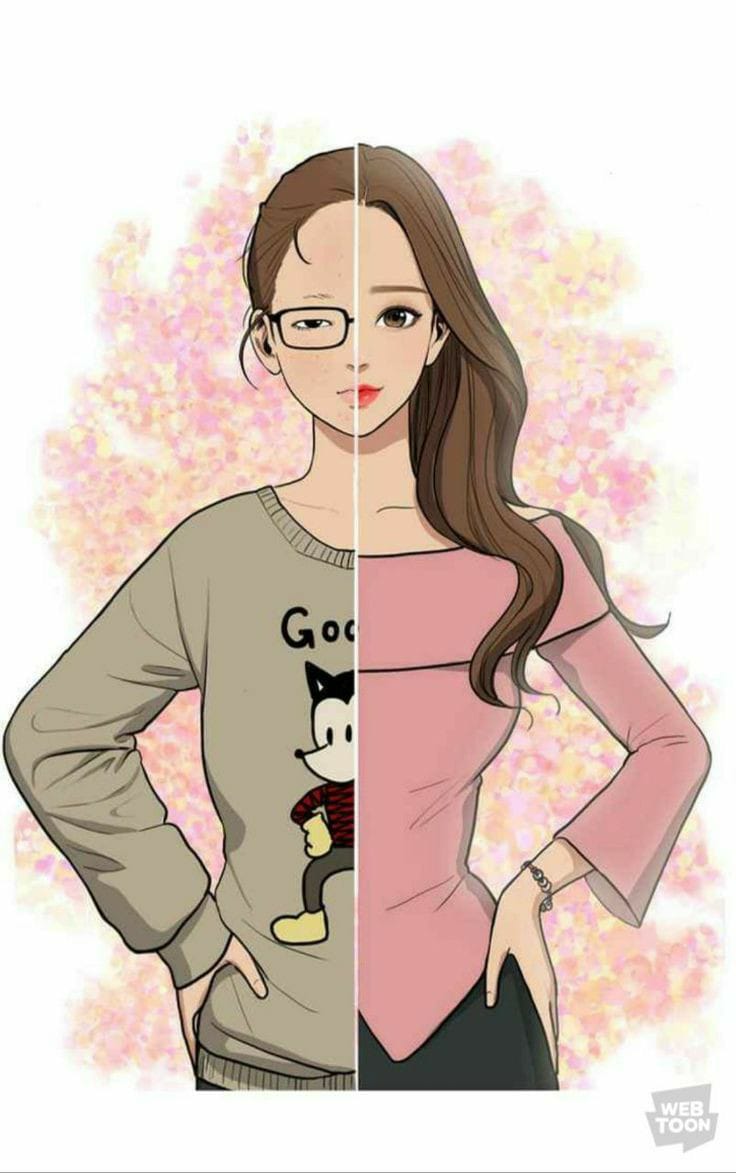
The popularity of Korean dramas in Indonesia is inseparable from the way the Korean Wave carries more than entertainment; it also carries ideas about how a woman should look. Rahmawati et al. (2023) note that Korean popular culture entered Indonesia through dramas in the early 2000s, influencing fashion, makeup, and even perceptions of beauty. (Setiawan et al. (2025)add that the spread of Hallyu has significantly shaped the construction of beauty standards, often creating social pressure for teenagers and young women. True Beauty is a clear example of this process because it presents a story that critiques beauty pressure while still rewarding a character for meeting it. This article argues that the drama both reproduces and questions dominant beauty norms, and that audiences interpret this contradiction in different ways.
True Beauty aired on tvN from December 2020 to February 2021, spanning 16 episodes and directed by Kim Sang-Hyub (Agusta & Wahyuni, 2023). The series is an adaptation of the popular webtoon The Secret of Angel (Damayanti et al., 2023; Nissi & Azeharie, 2022), which, according to Setiawan et al. (2025), was created by Yaongyi. Moon Ga Young stars as Lim Ju Kyung, while Cha Eun Woo plays Lee Su Ho, a popular student who is cold and dislikes being the center of attention (Nissi & Azeharie, 2022; Toruan et al., 2024). Ju Kyung is a high school student who, since childhood, has faced unfair treatment because her appearance was deemed not to meet South Korean beauty standards. After transferring to a new school, she learns to apply makeup through YouTube tutorials. Although she is subsequently praised for her beauty, she lives in constant fear that her true face will be revealed (Nissi & Azeharie, 2022; Rahmawati et al., 2023).
The pressure around Ju Kyung is not abstract, because it appears in concrete scenes. Damayanti et al. (2023) found that comments from her extended family, such as calling her an adopted child or suggesting she needs plastic surgery, are clear examples of beauty privilege. Hyun Bin’s rejection of her feelings, which ties her appearance to her intelligence, is another example. In one scene, Ju Kyung even begs her mother for permission to have plastic surgery because she sees it as the only way to end her suffering (Damayanti et al., 2023). According to the researchers, such portrayals tend to reinforce gender inequality, since women judged as unattractive are positioned as the ones at fault. In other words, the drama shows that beauty is treated not as a personal choice but as a social requirement that decides who is accepted and who is rejected (Setiawan et al., 2025).
Scholars have read these scenes through several lenses. Setiawan et al. (2025) use Peircean semiotics and argue that Ju Kyung’s bare face, her act of applying makeup, and her rejection of her natural appearance all point toward patriarchal beauty standards: fair skin, a high-bridged nose, and a slender figure. Her habit of covering her face with a helmet or a mask suggests that a face without makeup is considered unfit for public view. Nissi and Azeharie (2022) apply Goffman’s dramaturgy. Ju Kyung performs on the “front stage” when she presents herself at school, prepares on the “middle stage” when she applies makeup before her friends wake up, and relaxes on the “back stage” in her bedroom, where she can truly be herself. The visual style supports this reading. According to Rahmawati et al. (2023), the dim lighting in her bedroom conveys inner distress, while her pink, brightly lit vanity accompanies moments when she meets the standard.
If the drama can be read in so many ways, how do real viewers respond? Agusta and Wahyuni (2023) interviewed six Indonesian adolescents. Most perceived the bullying scenes as reflecting the reality of school life and acknowledged that the impact on victims, whether physical or verbal, can be severe. Some, however, viewed childhood teasing or family banter as mere jokes, and one rejected much of the drama’s portrayal. Personal experience, social media activity, and social circles shaped these differences. Toruan et al. (2024) reached a similar conclusion about imitation. Using Stuart Hall’s encoding/decoding framework, they found that five informants shifted positions from one scene to another. All agreed that a scene about imitating clothing style was imitation, yet three saw a scene about study style as motivation. Setiawan et al. (2025) caution that such interpretations can create psychological pressure, particularly for adolescent girls, if beauty is perceived as a prerequisite for social acceptance.
Even so, the story does not end with pressure. Istianah et al. (2025) apply Maslow’s hierarchy of needs and identify four stages in Ju Kyung’s journey: an identity crisis; the growth of self-esteem through the support of people close to her; confidence rooted in her own abilities; and self-actualization as she develops her potential in makeup artistry. Makeup, which initially served as a shield, becomes a medium for self-expression and professional skill. This journey suggests that self-acceptance is not a sudden event but a gradual process that depends on support from others. Setiawan et al. (2025) observe a similar sentiment in Su Ho’s remark that Ju Kyung remains beautiful even without makeup. Taken together, these studies show that True Beauty reproduces dominant norms while also opening space for critique (Setiawan et al., 2025). This is why media literacy matters for viewers, especially adolescents, so that they can enjoy such dramas while still questioning the messages they carry.
Writer: Yuli Lukita Sari – 202510360110043
References
Agusta, R., & Wahyuni, E. (2023). Bullying dalam drama Korea (Analisis resepsi dalam drama Korea True Beauty 2020). MUKASI: Jurnal Ilmu Komunikasi, 2(1), 98–110. https://doi.org/10.54259/mukasi.v2i1.1489
Damayanti, O., Rambe, W. P., & Srigati, B. (2023). Representasi kecantikan perempuan dan isu beauty privilege dalam serial drama Korea True Beauty. MASSIVE: Jurnal Ilmu Komunikasi, 3(1), 28–42. https://doi.org/10.35842/massive.v3i1.81
Istianah, U., Fatoni, A., & Hermawan, W. (2025). Representasi proses penerimaan diri tokoh utama dalam drama Korea True Beauty: Analisis psikologi sastra Maslowian. Bahtera Indonesia: Jurnal Penelitian Pendidikan Bahasa dan Sastra Indonesia, 10(2), 562–577. https://doi.org/10.31943/bi.v10i2.1323
Nissi, K., & Azeharie, S. (2022). Dramaturgi pada serial Korea True Beauty. Koneksi, 6(2), 440–448. https://journal.untar.ac.id/index.php/koneksi/article/view/15825
Rahmawati, H., Suhartami, W., & Irawanto, B. (2023). Beauty in South Korean TV drama series based on television artistic elements in the series “True Beauty.” Journal of Urban Society’s Arts, 10(2), 165–192. https://doi.org/10.24821/jousa.v10i2.8212
Setiawan, S. N., Rohanda, R., & Ramadhan, G. (2025). Representation of women’s beauty in the Korean drama “True Beauty”: A Peircean semiotics analysis. Jurnal Pembelajaran Bahasa dan Sastra, 4(5), 1123–1136. https://doi.org/10.55909/jpbs.v4i5.892
Toruan, R. R. M. L., Ashila, C. A. Z. J., & Djamal, M. F. (2024). Analysis of audience reception of Korean drama True Beauty regarding behavioral imitation. ICCD, 6(1), 458–466. https://doi.org/10.33068/iccd.v6i1.710