
Image soure: Marcus Yam – latimes.com
Introduction
South Korea is currently facing a serious population decline. Fewer people are being born, and this creates problems for the country’s economy in the long run. To deal with this, the government has started to rely more on foreign workers. On the surface, this looks like a smart and open policy. However, if we look deeper, the situation is not that simple. Many migrant workers in South Korea still face unfair treatment and hidden difficulties in their daily lives.
These problems are not always obvious. They don’t always come in the form of direct violence or clear discrimination. Instead, they appear through systems and structures that make life harder for migrants without people realizing it. This is what we can call systemic inequality, where the system itself creates unequal conditions.
South Korea’s Demographic Problem and Policy
South Korea’s low birth rate has pushed the country into a difficult situation. The government needs more workers to keep industries running and to support economic growth. Because of this, they have opened opportunities for migrant workers, especially in sectors like manufacturing, agriculture, and construction. However, these policies are mostly focused on economic needs rather than social inclusion. Migrant workers are often treated as temporary solutions, not as people who will become part of society. As a result, even though they are allowed to enter the country, they are not fully accepted. This creates a gap between policy and reality. They country needs migrants, but at the same time, it does not fully support their integration into society.
Hidden Forms of Exclusion in Daily Life
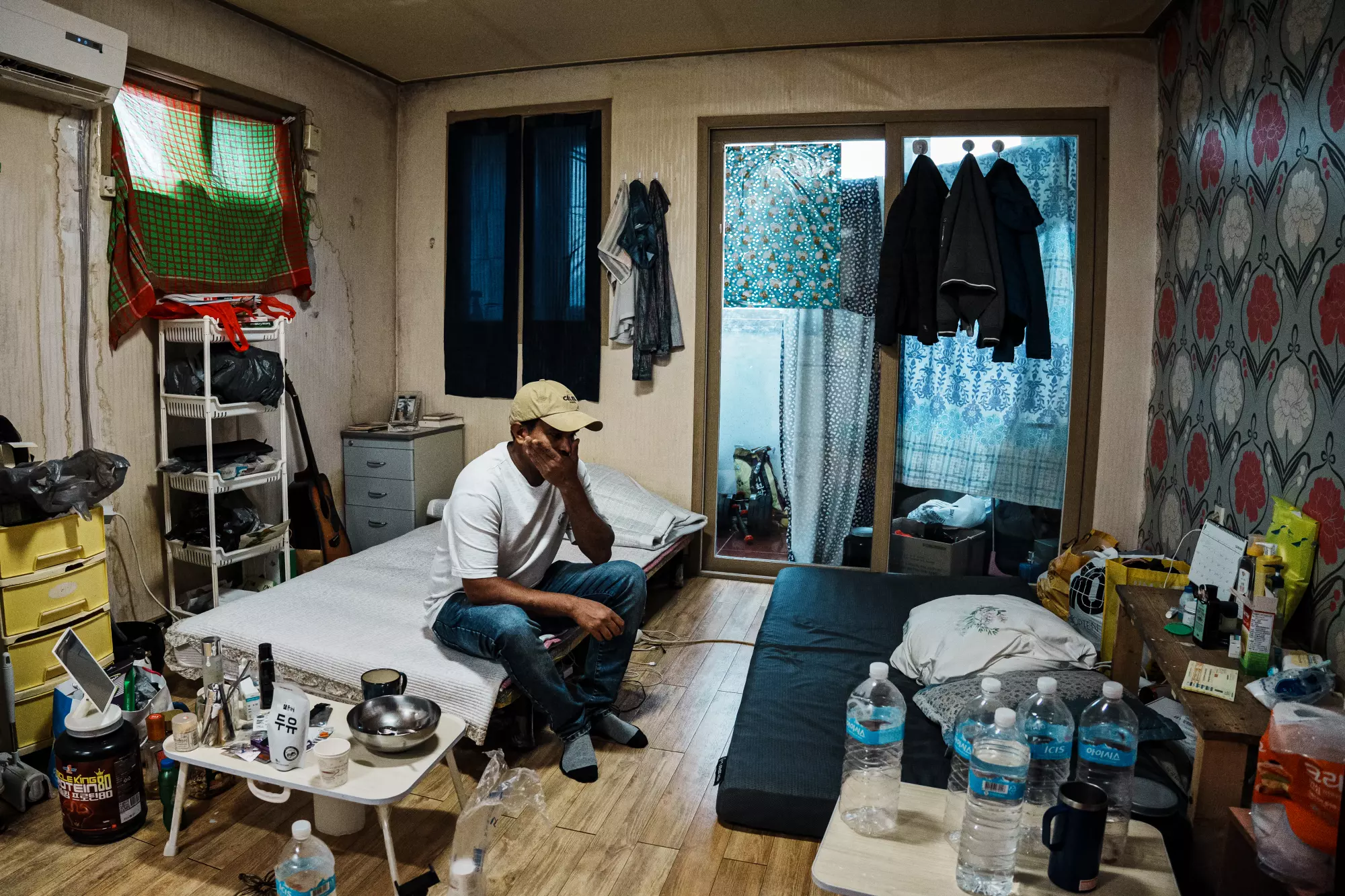
One of the biggest challenges faced by migrant workers is language. Many of them struggle to understand Korean, especially when dealing with important things like legal issues or healthcare. Without proper language support, they can easily get lost in complicated systems. Another issue is working conditions. Many migrant workers have a long working hours and limited time to rest. Because of this, they don’t have enough time or energy to learn the language, build relationships, or acces services. Over time, this make them feel isolated.
These problems might seem small at first, but when combined, they create serious barriers. Migrants are physically present in the countey, but socially, they remain seperated from the rest of society
Social Hierarchy and Discrimination
In South Korea, social hierarchy plays a big role in everyday interactions. There is a strong culture of seniority and power differences. This can leqd to unfair treatment, especially toward those who are seen as lower in status. Migrant workers are often placed at the bottom of this hierarchy. Because of this, they are more vulnurable to exploitation and unfair treatment at work. In some cases employers may abuse their power, knowing that migrants have limited options to complain or leave their jobs.
At the sime time, resistance to migrants is not only found among lower-income groups. Even in professional sectors, there is a tendency to protect local workers and limit opportunities for foreigners. This shows that the problem exists across different levels of society.
Conclusion and Opinion
In conclusion, South Korea’s immigration system shows a clear contradiction. On one hand, the country needs migrant workers to survive it’s demographic crisis. On the other hand, the systems still creates many barriers that prevent these workers from fully becoming part of society. This issue is important because it shows that economic policies alone are not enough. If a country wants to rely on migrant workers, it also needs to ensure fair treatment and equal opportunities.
From my perspective as an International Relations Student, this case shows that true development is not only about economic growth, but also about how a country treats the people within it. South korea needs to improve not just it’s policies, but also it’s social approach, so migrants are not just workers, but also recognized as part of the community
Writer: Rafli Achmad Valerino – 202410360110026
References:
International Organization for Migration (IOM). (2019). Migration in the Republic of Korea: Country profile. https://publications.iom.int/system/files/pdf/mp_korea.pdf
Kwak, Y. K., & Wang, M. S. (2022). Exclusion or inclusion: National policies on migrant workers in East Asia. International Journal of Environmental Research and Public Health, 19(23), 16270.
https://www.mdpi.com/1660-4601/19/23/16270
OECD. (2023). International migration outlook: South Korea.
https://www.oecd.org/migration/international-migration-outlook/