
Image source: Pinterest
Introduction
South Korea is changing from a society imagined as ethnically homogeneous into one where foreign students, workers, and migrants live beside Korean neighbours. The dispute over the Dar-ul-Emaan Kyungpook Islamic Center in Daehyeon-dong, Daegu, shows what this change looks like at street level. This essay argues that the case is neither a simple land-use quarrel nor proof that Koreans reject Muslims. Residents’ practical concerns are legitimate, but the way opposition was expressed, and the way local government first reacted, turned a planning matter into a question of religious freedom and non-discrimination. The essay applies three lenses: multiculturalism, human rights, and constructivism.
The Issue
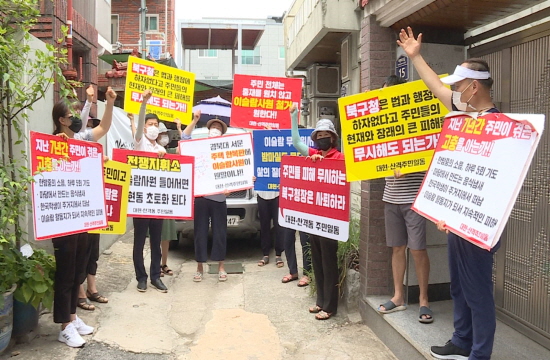
Muslim students at Kyungpook National University (KNU) had prayed since 2014 in a small house near campus and later planned a two-storey mosque there (Kuhn, 2023; Lee, 2022). The Buk District Office approved the project in September 2020 but suspended it in February 2021 after residents complained (Lee, 2022). Courts annulled the suspension as unjust and procedurally flawed (The Korea Times, 2021, 2022), and the National Human Rights Commission of Korea (NHRCK) recommended that construction resume (The Korea Times, 2022). Opposition continued: residents placed pig heads and cooked pork near the site (Choi, 2022), which the NHRCK called hate speech in March 2023 (Kuhn, 2023). Construction resumed in July 2023 (U.S. Department of State, 2024) but was reportedly halted again in December 2023; a relocation proposal followed in August 2026, with no known outcome (Asia Business Daily, 2026).
The dispute has two layers (Figure 1): a practical layer of noise, congestion, and a narrow alley (Asia Business Daily, 2026), and a symbolic layer of pork protests and reported anti-Muslim slurs (U.S. Department of State, 2022) aimed at Muslims as a group.
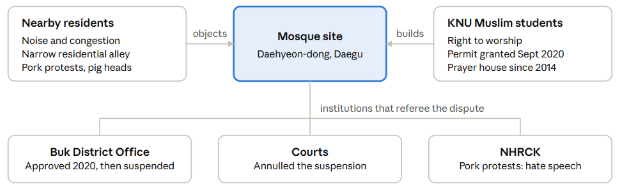
A land-dispute that became a religious dispute
- Why the Issue Matters
First, it tests multicultural practice. South Korea looks to immigration to offset an ageing workforce (Kuhn, 2023), so whether newcomers can build basic institutions, such as a place of prayer, shows whether diversity is accepted or merely used. Second, religious freedom is guaranteed by Article 20 of the Korean Constitution (Constitution of the Republic of Korea, 1987) and by the International Covenant on Civil and Political Rights (ICCPR), to which Korea is a party (U.S. Department of State, 2024). Third, the case exposes institutional gaps: Korea has no comprehensive anti-discrimination law covering religion (U.S. Department of State, 2022), and NHRCK recommendations are non-binding (U.S. Department of State, 2024). In 2025, a UN committee cited the Daegu backlash among its concerns about discrimination against migrants (The Korea Times, 2025).
- The Author’s Position
This section states the author’s argument, not established fact. First, the right to worship is firm, but its exercise may be regulated. Article 18(3) of the ICCPR permits restrictions only if they are lawful, necessary, and non-discriminatory (UN Human Rights Committee, 1993). Noise and traffic can be managed through neutral rules applied to every assembly building, whether church, temple, or mosque. Second, pig heads and pork barbecues cannot be defended as planning objections, because they reduce neither noise nor congestion; their function is contempt. Third, the district office’s first response worsened the problem. It reportedly cited residents’ emotional distress and fear of slums when suspending a permitted project (Kuhn, 2023), and the NHRCK later found its reasons rooted in prejudice (The Korea Times, 2024). Fourth, the conflict is not Korea versus Muslims. KNU scholars and civic groups backed the mosque (Kuhn, 2023), and many residents face real burdens. Relocation could be fair only if it is voluntary and not a reward for intimidation.
- International Relations Analysis
Multiculturalism. Kymlicka (1995) argues that liberal states should recognise minority rights when equal treatment alone leaves groups disadvantaged, while Taylor (1994) holds that misrecognition itself harms identity. A mosque is a public sign of belonging; hostile symbols at its gate send the opposite message. Kymlicka also ties group rights to respect for individual rights, so the students owe neighbours reasonable conduct. In the author’s interpretation, Korea welcomes students mainly as human capital, so their religious needs receive less recognition.
Human rights. Donnelly (2013) stresses that human rights belong to people simply as humans and protect them against majority pressure, which is vital for international students who cannot vote locally. The case shows an implementation gap rather than a missing norm: courts and the NHRCK applied the standards (Kuhn, 2023; The Korea Times, 2021), yet conflict persisted because local enforcement was weak and national remedies are advisory (U.S. Department of State, 2024).
Constructivism. Wendt (1999) argues that identities and interests are socially constructed through shared meanings. Shin (2006) shows that ethnic nationalism has long shaped Korean identity; where belonging is imagined ethnically, lawful Muslim residents can still be seen as outsiders. This helps explain why a land-use dispute became symbolic, and why pork, which targets religious identity directly, became the weapon of protest. Constructivism also shows change is possible: norm entrepreneurs redefine acceptable behaviour (Finnemore & Sikkink, 1998), a role the NHRCK, courts, and KNU academics play here. A caution: evidence on residents’ motives is limited.
Conclusion
The Daehyeon-dong dispute lies between tolerance and discrimination. Korean courts and institutions defended the Muslim community’s rights, so the case does not show that Koreans reject Muslims; yet pork-based protest and a prejudice-based suspension show that tolerance was incomplete. The most defensible path protects the right to worship, regulates conduct through neutral rules, and takes residents’ practical concerns seriously without letting harassment decide the outcome.
Writer: Ahmad Ziya Hafizi – 202510360110036
References
Asia Business Daily. (2026, August 10). Daegu Bukgu offers alternative site for suspended mosque project. https://view.asiae.co.kr/en/article/2026081011404767378
Choi, J.-h. (2022, November 14). Mosque project pits villagers against Muslims in Daegu. The Korea Herald. https://asianews.network/mosque-project-pits-villagers-against-muslims-in-daegu/
Constitution of the Republic of Korea. (1987).
Donnelly, J. (2013). Universal human rights in theory and practice (3rd ed.). Cornell University Press.
Finnemore, M., & Sikkink, K. (1998). International norm dynamics and political change. International Organization, 52(4), 887–917.
Kuhn, A. (2023, May 24). Muslims in South Korea want to build a mosque. Neighbors protest and send pig heads. NPR. https://www.npr.org/2023/05/24/1176132837/south-korea-mosque-muslim-students-tensions
Kymlicka, W. (1995). Multicultural citizenship: A liberal theory of minority rights. Oxford University Press.
Lee, H.-j. (2022, May 3). Mosque construction triggers standoff in Daegu. The Korea Times. https://www.koreatimes.co.kr/southkorea/globalcommunity/20220503/mosque-construction-triggers-standoff-in-daegu
Shin, G.-W. (2006). Ethnic nationalism in Korea: Genealogy, politics, and legacy. Stanford University Press.
Taylor, C. (1994). The politics of recognition. In A. Gutmann (Ed.), Multiculturalism: Examining the politics of recognition (pp. 25–73). Princeton University Press.
The Korea Times. (2021, December 2). Court rules against administrative order to halt mosque construction in Daegu. https://www.koreatimes.co.kr/southkorea/society/20211202/court-rules-against-administrative-order-to-halt-mosque-construction-in-daegu
The Korea Times. (2022, April 22). Appeals court sides with Islamic community, cancels suspension of mosque construction in Daegu. https://www.koreatimes.co.kr/southkorea/globalcommunity/20220422/appeals-court-sides-with-islamic-community-cancels-suspension-of-mosque-construction-in-daegu
The Korea Times. (2024, April). Korean Muslim YouTuber to build mosque in Incheon. https://www.koreatimes.co.kr/www/nation/2024/04/113_372910.html
The Korea Times. (2025, May 13). UN committee slams Korea’s treatment of migrants, foreign workers. https://www.koreatimes.co.kr/southkorea/society/20250513/un-committee-slams-koreas-treatment-of-migrants-foreign-workers
UN Human Rights Committee. (1993). General comment No. 22: The right to freedom of thought, conscience and religion (Art. 18) (CCPR/C/21/Rev.1/Add.4). United Nations.
U.S. Department of State. (2022). 2021 report on international religious freedom: South Korea. https://www.ecoi.net/en/document/2074123.html
U.S. Department of State. (2024). 2023 report on international religious freedom: South Korea. https://www.ecoi.net/en/document/2111957.html
Wendt, A. (1999). Social theory of international politics. Cambridge University Press.