
In just one generation, South Korea has transitioned from being recognized primarily for swift industrial growth and a divided nation to being celebrated for K-pop, television dramas, films, and food. This essay explores the Korean Wave (Hallyu) as a tool of South Korean soft power. This matter is significant for two reasons. Initially, it demonstrates how a moderately sized state confronting a nuclear-equipped neighbor can develop international influence without primarily depending on military or economic intimidation. Secondly, it allows us to evaluate a significant international relations idea through a practical example: is it possible for cultural appeal to be transformed into diplomatic and economic benefits? I contend that Hallyu is a true soft power asset, but its political significance is dependent, and Seoul ought to view it as an addition to traditional diplomacy instead of a replacement.
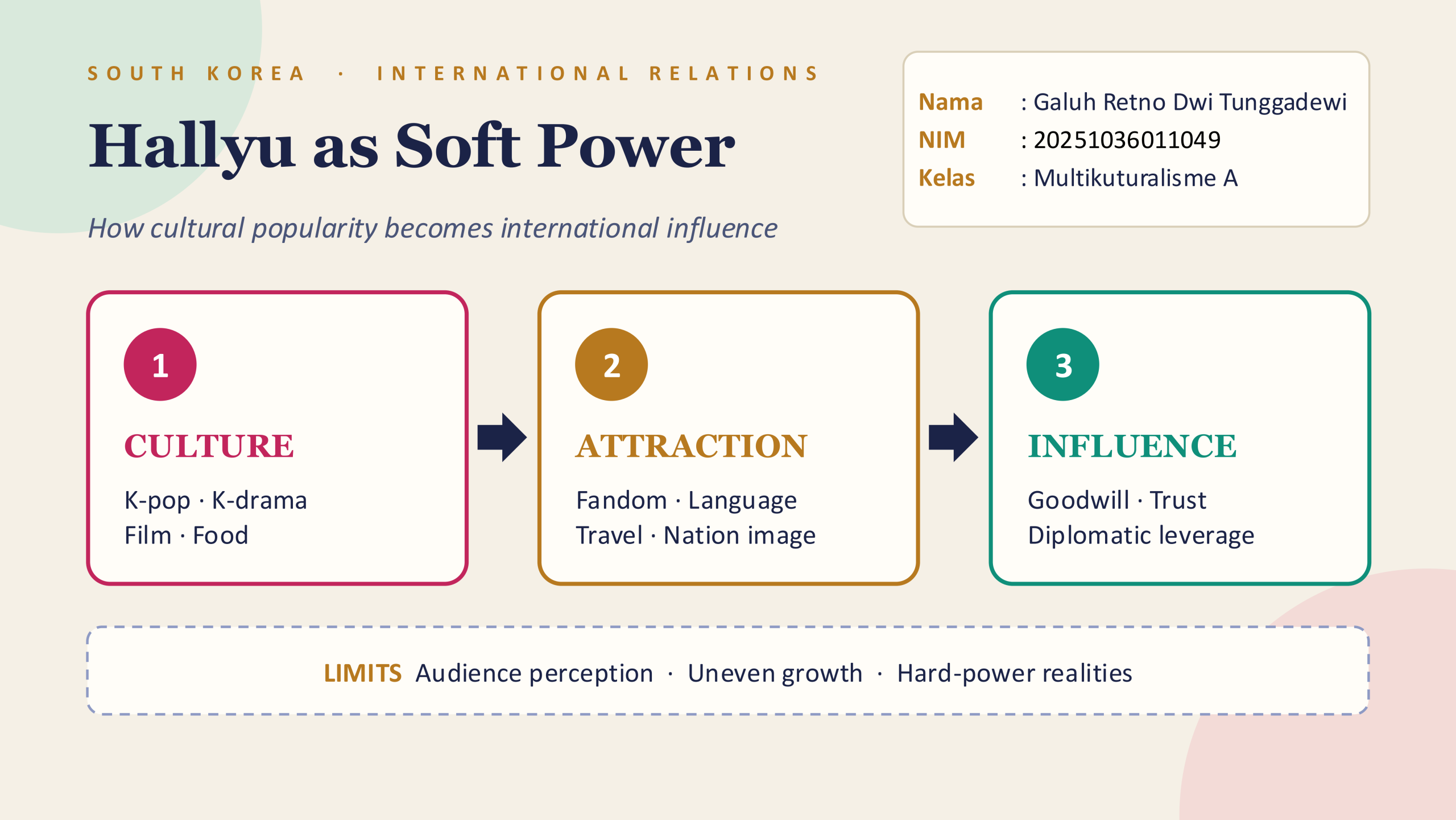
(J. S. Nye, 2004) describes soft power as the capacity to achieve desirable results through appeal instead of force or financial incentives. It depends on a nation’s culture, political beliefs, and foreign policies for others to view them as legitimate. (J. S. Nye, 2021) subsequently explains that resources do not equate to power by themselves; they transform into soft power only when they influence the preferences of others, making the audience’s perception as significant as the producer’s intent. (J. Nye & Kim, 2013) utilize this perspective specifically for the Korean Wave, and it has become a commonly used framework for analyzing Hallyu.
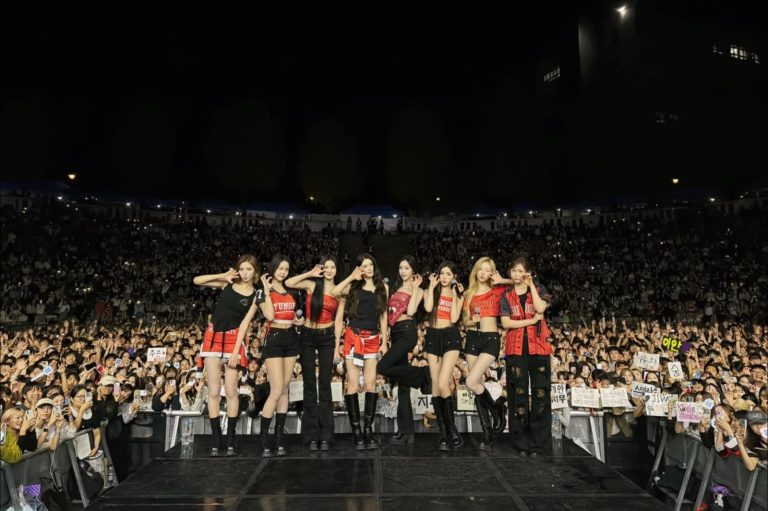
Hallyu is not merely a coincidence of the market. (H.-K. Lee, 2013) demonstrates that South Korean cultural policy has adopted a transnational and consumer-oriented direction, reinterpreting Korean culture as universal “K-culture” and establishing public-private collaborations where Korean Wave initiatives fulfill both governmental and commercial goals. (Jin, 2016) situates the current phase of the Korean Wave in the era of social media, where digital platforms enable Korean content to spread worldwide with reduced traditional gatekeeping. The magnitude is now significant. A report from 2026 indicated that exports related to Hallyu approached US$19 billion in 2025, with growth credited to the Netflix sensation KPop Demon Hunters and to AI-enhanced personalization services that boosted worldwide fandom (Cha, 2026) .
From a soft power viewpoint, these numbers are less significant for their market worth than for what they imply regarding appeal. Fans who study Korean, visit Seoul, or purchase Korean goods demonstrate that Korea’s image is now linked with innovation and modernity instead of solely with conflict. This type of image serves as a diplomatic advantage: it can reduce the expenses of collaboration, make Korean efforts more accepted, and enhance the nation’s stance in contexts where it needs to convince instead of dictate. According to (J. S. Nye, 2004) , Korea has become appealing through culture, which is a key source of soft power.
Yet, the same idea reveals the constraints of the Hallyu approach. Initially, interest in cultural products does not inherently lead to political alignment. An individual may enjoy K-pop and simultaneously oppose Korean foreign policy, making the connection between popularity and policy results likely but difficult to demonstrate. Secondly, the soft power model often envisions influence radiating outward from a national origin. (Wall, 2026) contends that the prevailing nationalist perspective interprets the “K” in K-pop or K-drama as signifying the nation-state, depicting cultural influence as a unidirectional flow, and he examines KPop Demon Hunters to explore the true essence of “Koreanness.” In that case, the state cannot completely assert or manage what renders Hallyu appealing. Third, growth is inconsistent: a Korean business newspaper mentioned that Hallyu was increasing in the West but decreasing in Thailand and Vietnam(J. Lee, 2026) , highlighting that appeal can diminish. Ultimately, (J. S. Nye, 2004) considers soft power to be an addition to hard power. South Korea continues to confront a nuclear-capable North Korea and depends on deterrence and alliances that cultural favor cannot substitute.
I believe Hallyu merits the funding it gets, but the government must be prudent in its investment methods. (H.-K. Lee, 2013) observes that current policy recognizes international fan engagement as an indicator of the value of cultural industries. This commercial approach is beneficial, but excessive state control risks transforming creative efforts into propaganda, which audiences can easily recognize and which would undermine the authenticity that generates appeal. Since attraction is determined by the audience (J. S. Nye, 2021) , the optimal role of the state is to enable rather than dictate: providing funding for training, safeguarding creators’ working standards, promoting translation and Korean language education, and expanding beyond a limited number of blockbuster successes and a few international streaming services. Reliance on each is a tactical weakness. Hallyu must be associated with tangible diplomacy, including educational exchanges and development cooperation, to ensure goodwill transforms into enduring relationships instead of fleeting enthusiasm.
In summary, Hallyu demonstrates that a nation can enhance its global reputation through appeal, and the popularity of KPop Demon Hunters indicates that the approach continues to thrive. However, soft power theory also emphasizes that attraction is seen, delicate, and not automatically occurring. Consequently, South Korea’s task is not so much about generating more successes but rather safeguarding the creative liberty that enhances their attractiveness and aligning cultural impact with reliable, steady diplomacy.
Writer: Galuh Retno Dwi Tunggadewi – 202510360110049
References
Cha, M. (2026, July 8). Hallyu generated US$19bil in South Korean exports in 2025: Report. The Star. https://m.koreaherald.com/article/10800924
Jin, D. Y. (2016). New Korean Wave: Transnational Cultural Power in the Age of Social Media. University of Illinois Press. https://doi.org/0.5406/illinois/9780252039973.001.0001
Lee, H.-K. (2013). Cultural policy and Korean Wave: From national culture to transnational consumerism. In Y. Kim (Ed.), The Korean Wave: Korean Media Go Global (pp. 185–198). Routledge.
Lee, J. (2026, July 7). Hallyu Exports Near $19 Billion… Led by “K-Pop Demon Hunters.” The Asia Business Daily. https://view.asiae.co.kr/en/article/2026070709132353819
Nye, J., & Kim, Y. (2013). The Korean Wave: Korean Media GoGlobal (Y. Kim, Ed.; 1st ed.). Routledge. https://www.perlego.com/book/1545236/the-korean-wave-korean-media-go-global-pdf
Nye, J. S. (2004). Soft Power: The Means to Success in World Politics (1st ed.). PublicAffairs. https://books.google.co.id/books?id=wuqOAAAAMAAJ&redir_esc=y
Nye, J. S. (2021). Soft power: the evolution of a concept. Journal of Political Power, 14(1), 196–208. https://doi.org/10.1080/2158379X.2021.1879572
Wall, B. (2026). Issue Brief Beyond Soft Power: KPoP Demon Hunters and the Rise of Inclusive Koreanness.