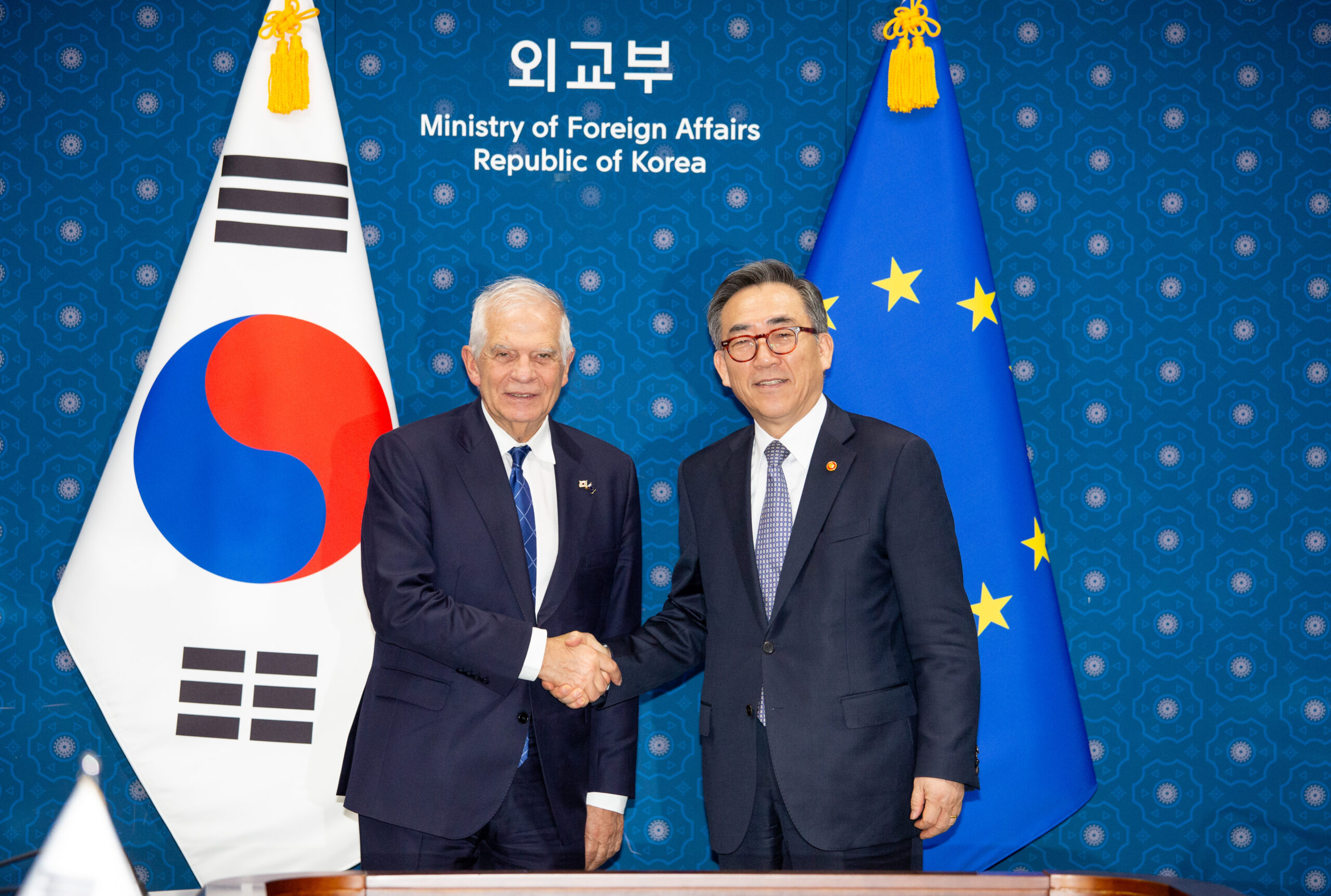

Image source: Chung Sung-Jun – REUTERS
Introduction
In the current era of global systemic conflict states are increasingly compelled to rethink their strategies in order to respond to emerging security challenges. The international system is experiencing growing instability due to multiple geopolitical tensions, including the war in Ukraine, intensifying strategic competition between major powers, the rise of China, and the evolving security dynamics in the Indo-Pacific region. As a result, many countries are strengthening partnerships and seeking cooperation with “Like-minded” actors to balance these challenges. Within this context, the relationship between the Republic of Korea (ROK) and European Union (EU) has gained new strategic significance. On 04 November 2024, the EU and South Korea officially signed a Security and Defence Partnership, marking a major step in their bilateral relations. This agreement reflects a shared commitment to uphold a rules-based international order and to deepen cooperation in a wide range of security areas.
Discussion
The intensification of geopolitical rivalry has transformed the global security environment. Russia’s invasion of Ukraine has not only destabilized Europe but has also had global implications, reinforcing alliances and reshaping strategic partnerships. At the same time, China’s increasing assertiveness in regional and global affairs, along with the deepening strategic cooperation between Russia and North Korea, has heightened security concerns in both Europe and Asia. These developments have reinforced the perception that security challenges are increasingly interconnected across regions. Another factor influencing the EU’s strategic Thingking is uncertainty regarding the long-term reliability of USA as a security guarantor. Political developments in the USA, including the possibility of more alliance skeptical leadership, have encouraged European policymakers to diversify their partnersips. Consequently, the EU has sought to strengthen relations with democratic and capable partners beyond Europe, particularly in the Indo-Pacific region. South Korea has emerged as a key partner within this strategy.
One of the central foundation of the ROK-EU partnership is the concept of “Like-minded”. Since the establishment of their strategic partnership in 2010, both sides have emphasized their shared commitment to democracy, human rights, rule of law, and respect for international law as enshrined in the United Nations Charter. These common values form the normative basis of their cooperation. Within the EU’s foreign policy framework, “Like-minded’ partners are actors that share similar political principles and are willing to cooperate in maintaining a rules-based international order. South Korea stands out in Asea as one of the region’s few consolidated democracies with strong economic, technological, and diplomatic capabilities. This makes Seoul an attractive and relatively non-controversial partner for the EU. The partnership also reflects a broader understanding of security. Rather than focusing solely on traditional military threats, the ROK and EU increasingly adopt a comprehensive approach that include 15 security and defence areas, there are International peace and crisis management, maritime security, cyber security, hybrid threats, strategic communications and countering foreign information manipulation and interference (FIMI), critical infrastructure, countering violent extremism, non-proliferation, disarmament, conventional arms including small arms and ligh weapons. Space security and defence, training and education in security and defence, exchange of information on defence industrial related matters, peace meadiation and conflict prevention, economic security, human trafficking, and women security.
South Korea’s growing role as a security provider has been key factor behind EU’s decision to elevate the partnership. Seoul has demonstrated its strategic value through its respons to the war in Ukraine. Although South Korea has avoided direct arms transfers to Ukraine it has provided substantial humanitarian and financial assistance while indirectly contributing to European defence capabilities through arms exports. In particular, South Korea’s defence industry has attracted significant attention in Europe. Its ability to rapidly produce military equipment such as artillery systems, tanks and ammunitions has been especially valuable for European states seeking to strengthen their defence capacity. Major arms deals with countries such as Poland have highlighted south Korea’s role as a reliable defence partner. These developments have strengthened calls within Europe for deeper security cooperation with Seoul.
Beyond defence production, South Korea also possesses strong capabilities in cyber security, advanced technology, and peacekeeping operations. These capacities make it an important contributor to international security initiatives. Moreover, South Korea’s geographic position in East Asia allows it to function as a strategic bridge between Europe and the Indo-Pacific region. Furthermore, through these initiatives, the ROK and EU aim to deepen policy coordination and enhance their ability to respond to global security challenges. The partnership also complements existinf frameworks such as the EU-ROK framework agreement, and the framework participation agreement for EU crisis management operations.
Conclusion
The ROK-EU Security and Defence Partnership reflects the growing interconnected betweeb European and Indo-Pacific security dynamics. In a period marked by geopolitical uncertainty and systemic competition, both actors recognize the need to strengthen cooperation with trusted partners. Shared democratic values, south korea’s expanding security capabilities, and the changing global strategic environment have collectively driven the EU to elevate seoul as a key partner. Ultimately, the partnership demonstrates that cross regional cooperation is becoming increasingly important in maintaining international stability. Rather than simply extending Europe’s presence in the indo pacific, the agreement also highlights South Korea’s strategic agency as a middle power actively contributing to a more networked and cooperative global security.
Writer: Athirah Azzahrah Nirwan – 202410360110066
References
CEIAS. (2025). Developing Security Relations Between South Korea and The EU under a “Like-minded” paradigm. Retrieved from https://ceias.eu/developing-security-relations-between-south-korea-and-the-eu-under-a-like-minded-paradigm/. Openned 15 March 2026
EIAS. (2025). EU-South Korea-Japan : Revitalizing Defence and Security Ties in a Changing Geopolitical Landscape. Retrieved From https://eias.org/publications/op-ed/eu-south-korea-japan-revitalizing-defence-and-security-ties-in-a-changing-geopolitical-landscape/. Openned 15 March 2026
European Union. (2024). “Security and Defence Partnership between the European Union and the Republic of Korea”. https://www.eeas.europa.eu/eeas/security-and-defence-partnership-between-european-union-and-republic-korea_en. Retrieved on 03 March 2026
La Feld, Simon De. (2024) EU, South Korea sign defence agreement. Borrell asks Seoul to step up support for Ukraine. Retrieved from https://www.eunews.it/en/2024/11/04/eu-south-korea-sign-defence-agreement-borrell-asks-seoul-to-step-up-support-for-ukraine/. Openned 15 March 2026
Ministry of Foreign Affairs Republic of Korea. (2025). Press Release the 1st ROK-EU Security and Defence Dialogue Held. Retrieved from https://www.mofa.go.kr/eng/brd/m_5676/view.do?seq=323184. Openned 15 March 2026
Pardo, P, R. (2024). The EU-South Korea Security and Defence Partnership. Retrieved from https://csds.vub.be/publication/the-eu-south-korea-security-and-defence-partnership/. Openned 15 March 2026
Tereza Novotná & Thomas Christiansen & Moosung Lee, (2023). “EU-Korea relations at 60: managing cooperation in the context of great power rivalry,” Asia Europe Journal, Springer, vol. 21(4), pages 481-492, December. Openned 03 March 2026