
Image source: Pinterest
Introduction
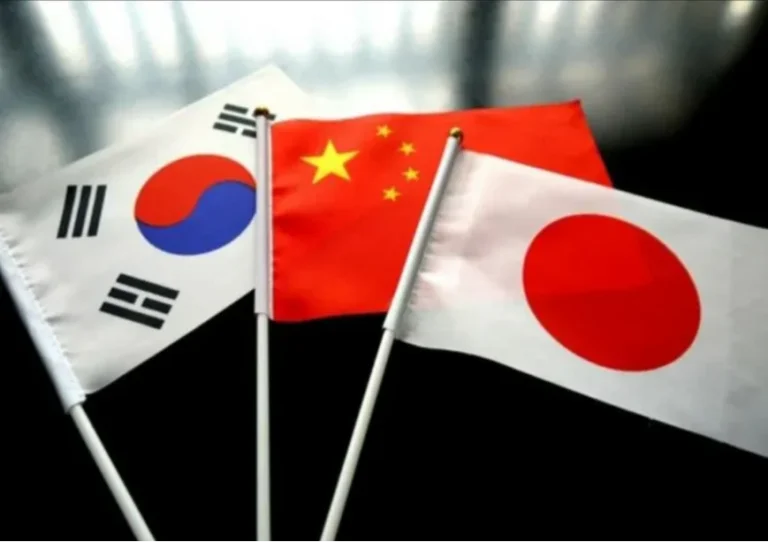
South Korea, a state with a unique cultural homogeneity that is increasingly popular among the international community, especially Southeast Asian states. Located between Japan and China in East Asia, South Korea’s position is never separate from a complex relationship, close economically, yet often tense politically and historically. To this day, the three states remain interconnected in trade and regional security issues, but memories of the past and geopolitical rivalries continue to influence perceptions and policies toward each other.
The historical conflict between South Korea and Japan occurred because of the Japanese textbook, which claimed that the colonization of Korea was an “advancement” instead of “aggression”. This statement led to demonstrations in order to revise the truth. Moreover, Japan’s government responded to this issue by changing the actual fact, yet it is still controversial because it deleted the “comfort women” issue from the textbook (Hahm & Heo, 2019).
Additionally, the historical claims over Goguryeo and the dispute ober Leodo marked the tension between South Korea and China, which were related to maritime boundaries. This dispute also led to ongoing demonstrations; some aggressively claimed Koreans’ right to Gojoseon (Old Joseon), and others tried to expand this as part of a territorial claim over Gando (Jiando) through offensive and nationalistic rhetoric(Sin-Cheol, n.d.).
Those diverse conflicts shaped South Korea’s foreign policy, especially toward Southeast Asian states, which have huge “Korean lover” communities, such as K-Pop fans, K-Drama enjoyers, or even daily-beauty enthusiasts. Being an ex-colonized state, South Korea indirectly refuses any kind of colonization; that’s why this paper will examine how South Korea’s historical disputes shaped its foreign policies toward Southeast Asian states through one of the IR perspectives named “constructivism” to know that every action of an actor (South Korea) is socially constructed.
South Korea’s Identity as a Colonized State
South Korea experienced a long period of colonization that resulted in human rights violations, limited domestic development, and an identity crisis. In response to this historical experience, the state developed an anti-colonial identity and implemented this effort both through its domestic and foreign policies. This commitment is executed through the implementation of the Sustainable Development Goals (SDGs) in addressing global inequalities (Park & Park, 2024). South Korea promotes inclusive development, social justice, and greater opportunities for poor residents through this framework. Additionally, the state positions itself as an advocate of international norms that emphasize human rights protection and sustainable development.
Furthermore, South Korea’s identity transformation from a colonized state to an active global actor that creates new global aid standards can be seen through the partnership pattern toward developing states, rather than the patron-client relationship, which represents colonization culture. This approach emphasizes knowledge transfer and institutional capacity upgrade, which makes it possible to create a state to be autonomous economically. Integrating social justice norms, South Korea puts effort into reducing global dependencies. This inclusivity principle is relevant to be implemented toward ASEAN states’ development cooperation, especially after the establishment of the Comprehensive Strategic Partnership (CSP) at the 25th ASEAN-ROK summit(ASEAN-Korea Economic Relations – ASEAN Main Portal, n.d.).
South Korea’s SDGs Foreign Policy Implementations toward ASEAN States
South Korea’s anti-colonialism identity manifestation can be seen through the cooperation pattern between this state and Southeast Asian states through the SDGs’ implementation, which emphasizes cooperation equal partnership principle model that respects states’ sovereignty. This approach was born from the historical realization as a same colonized state, so any kind of aids will be recognized as civil empowerment and development of the social capacity quality. Thus, South Korea is a strategic partner for ASEAN states that try to stop global economic dependency through inclusivity and social justice rather than being a financial backer only.
Economically, South Korea has established several cooperations with ASEAN states; even ASEAN is South Korea’s second-largest trading partner, with a two-way trade volume of US 208 billion dollars in 2022 (Korean Companies Making Waves in ASEAN | UOB ASEAN Insights, n.d.). This agreement can happen because of the large number of South Korea’s cultural consumers in Southeast Asia, which becomes a great opportunity for both sides. In other words, this agreement could create many job opportunities for those states, resulting in a decrease in the percentage of poverty in the region, which is one of the main goals of the SDGs.
Moreover, South Korea actively promotes educational agreements in order to enhance the quality of the educational system, especially within ASEAN states. The 2nd ASEAN-Korea Forum on the Future of Education in 2022 was a great example of this implementation, in which these states were discussing the usage of digital platforms that may help to increase the quality of education. Kao Kim Hourn, the Secretary-General of ASEAN, argued that the usage of digital technology can make education more inclusive and accessible, even though he admitted that this technology remains a major challenge (ASEAN Main Portal, n.d.). This agreement proved that South Korea actively supports the SDGs implementation globally, which is aligned with its ideology in fighting human rights violations and promoting global prosperity.
Writer: Muhammad Aufa Rafiqi – 202410360110022
Conclusion
South Korea’s historical disputes with Japan and China played a significant role in shaping its national identity and foreign policy orientation. As a colonized state, South Korea has developed an anti-colonial norm that influences how they act internationally. Using constructivism perspective, this identity explains why South Korea tends to promote equality, prosperity, and inclusive development. This movement can be seen through its relations with developing states, especially Southeast Asian states, as their partner.
The global implementation of this identity is realized by South Korea through the realization of the Sustainable Development Goals (SDGs). By strengthening trade relations with ASEAN and promoting initiatives, South Korea contributes to regional development while also fostering mutually beneficial partnerships. These policies explain how South Korea’s historical memory can shape its efforts in promoting inclusive growth, reducing inequality, and supporting sustainable development in Southeast Asia.
Bibliography
2nd ASEAN-Korea Forum on the Future of Education spotlights digital transformation in education – ASEAN Main Portal. (n.d.). Retrieved March 12, 2026, from https://asean.org/2nd-asean-korea-forum-on-the-future-of-education-spotlights-digital-transformation-in-education/
ASEAN-Korea Economic Relations – ASEAN Main Portal. (n.d.). Retrieved March 10, 2026, from https://asean.org/our-communities/economic-community/integration-with-global-economy/asean-korea-free-trade/
Hahm, S. D., & Heo, U. (2019). History and territorial disputes, domestic politics, and international relations: An analysis of the relationship among South Korea, China, and Japan. Korea Observer, 50(1), 53–80. https://doi.org/10.29152/KOIKS.2019.50.1.53
Korean Companies Making Waves in ASEAN | UOB ASEAN Insights. (n.d.). Retrieved March 12, 2026, from https://www.uobgroup.com/asean-insights/articles/south-korean-companies-making-waves.page
Park, K. R., & Park, Y. S. (2024). Addressing institutional challenges in sustainable development goals implementation: Lessons from the Republic of Korea. Sustainable Development, 32(1), 1354–1369. https://doi.org/10.1002/sd.2725
Sin-Cheol, L. (n.d.). Korea-China-Japan Historical Disputes: Structure and Alternatives.