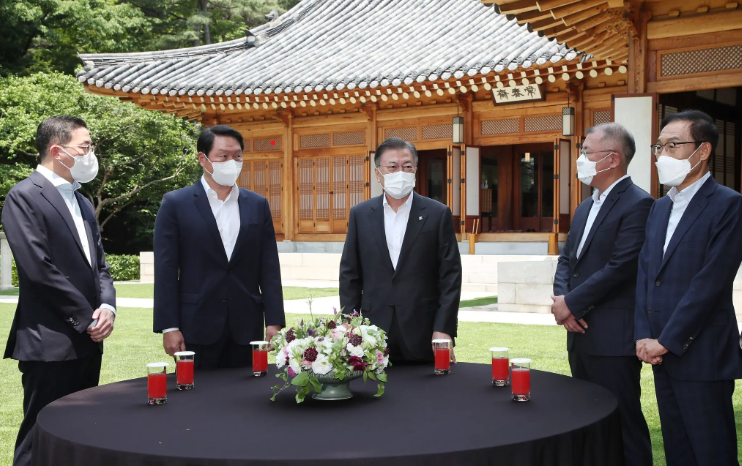

Image source: Yonhap – The New York Times (2021)
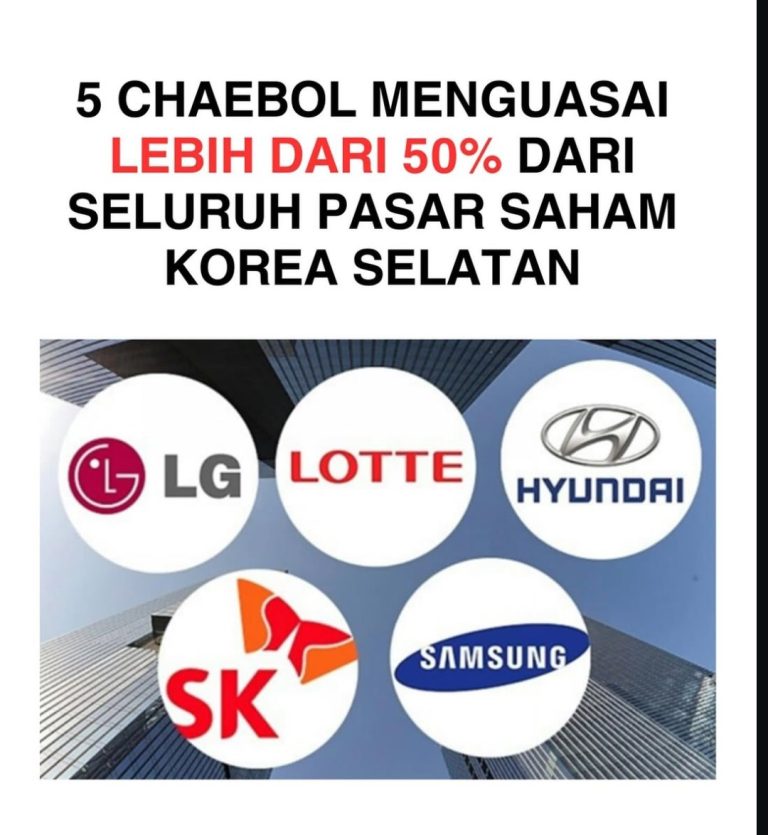
South Korea’s rapid economic transformation is often regarded as an extraordinary success story. Behind this achievement lies the crucial role of large family-owned conglomerates, known as chaebols, such as Samsung and Hyundai. These companies have and enhancing global competitiveness. However, their growing power has also raised concerns about democratic governance in South Korea.
Chaebols began to emerge during the government-led development period of the 1960s and 1970s, Most chaebols originated during the Japanese occupation period in World War II and experienced remarkable growth during the post-Korean War reconstruction efforts (Kim, 2025). When the government provided financial assistance and various policy advantages to specific companies. In return, these companies made significant contributions to the nation’s economic growth. Over time, chaebols expanded into various industrial sectors and amassed immense economic power. Today the chaebols dominate key sectors of the Korean economy, acting not only as economic players but also as significant political influence.
One of the main issues is the strong ties between chaebols and the political elite. Various corruption scandals involving business leaders and government officials point to the possibility of collusion. This undermines accountability in a democratic system, as the policies adopted tend to prioritize corporate interests over those of the general public. From a political economy perspective, this situation reflects an imbalance of power, where the economic elite holds the power to influence the course of politics. On the other hand, chaebols dominance hinders healthy competition. Small and medium-sized enterprises often struggle to compete with large conglomerates, which ultimately widens the economic gap and hinders social mobility. This situation contradicts the democratic principle of equal opportunity. When economic dominance is concentrated in the hands of a few, it can quickly transform into political influence that weakens democratic institutions.
From an international relations perspective, this can be linked to the concepts of political economy and liberalism. In theory, liberalism emphasizes free markets and a fair system. However, in the case of South Korea, it appears that excessive market concentration can disrupt that balance. The state, which should act as a regulator, has in some cases appeared to be too closely aligned with major economic actors.
Furthermore, chaebol dominance can also be viewed as a form of power inequality within the state. In political economy theory, when economic power is concentrated in the hands of a handful of actors, they possess greater ability to influence public policy. This can result in a democratic process that no longer fully represents the interests of the people. In other words, democracy continues to function formally, but substantively it can be weakened
Additionally, this situation can also affect public trust in the government. When the public perceives a close relationship between the government and large corporations, the perception arises that the system is not functioning fairly. In the long term, this can reduce public political participation and increase social dissatisfaction. If not properly addressed, this situation has the potential to lead to political instability. However, on the other hand, it cannot be denied that chaebols also provide many benefits. They create jobs, boost exports, and drive technological innovation. In fact, South Korea’s success in becoming one of the world’s leading nations is inseparable from the role of chaebols. Therefore, the issue lies not in the existence of chaebols themselves, but in how their power is regulated.
In my view, these chaebols have two sides. On the one hand, they play a major role in South Korea’s economic progress. On the other hand, if not managed properly, they can threaten the functioning of democracy. Therefore, the government must establish stricter and clearer regulations to prevent the chaebols from becoming too dominant. Additionally, more support is needed for small and medium-sized enterprises to ensure fairer competition.
In conclusion, the existence of chaebols is vital to South Korea’s economy, but it also poses challenges to democracy. Therefore, achieving a balance between economic growth and political justice is of the utmost importance. If South Korea can manage this effectively, the country will not only continue to grow economically but will also have a stronger and healthier democratic system.
Writer: Julia Fauzia Rahma – 202410360110031
References:
Kim, A. (2025, May 28). South Korea’s chaebol state: A democratic contradiction. Bruin Political Review. https://bruinpoliticalreview.org/articles?post-slug=south-korea-s-chaebol-state-a-democratic-contradiction-
Horowitz, S. (2002). Democratization, dispersed interest groups, and economic reform in South Korea. East Asia, 19(2), 3–38. https://doi.org/10.1007/s12140-002-0004-x
Ministry of Foreign Affairs of Italy. (2025). South Korea: The power of innovation between chaebol and K-culture.
https://www.esteri.it/en/sala_stampa/archivionotizie/diplomazia-economica/2025/12/corea-del-sud-la-potenza-dellinnovazione-tra-chaebol-e-k-culture/
The New York Times. (2017, May 8). South Korea election and chaebol reform debate.
https://www.nytimes.com/2017/05/08/business/dealbook/south-korea-election-chaebol-samsung.html
The New York Times. (2023, December 18). Chaebol in South Korea.
https://www.nytimes.com/2023/12/18/business/chaebol-south-korea.html