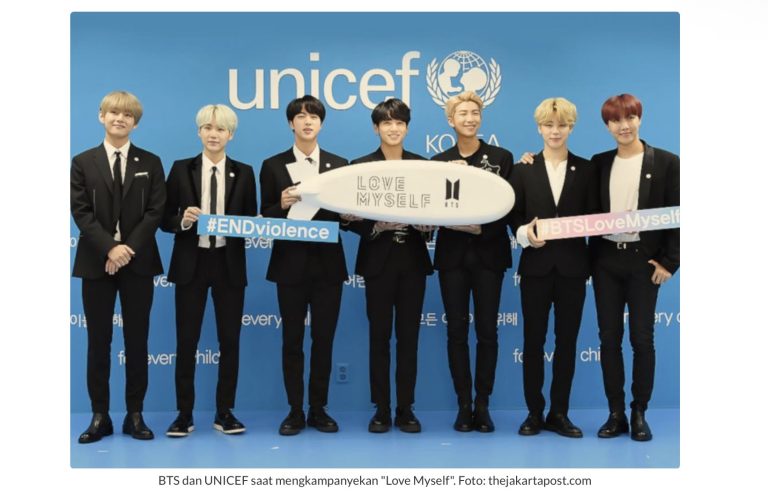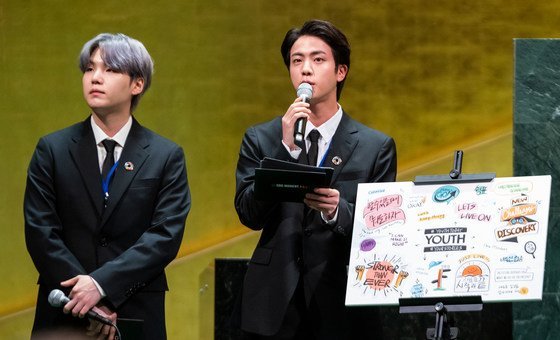

Image source: Pinterest
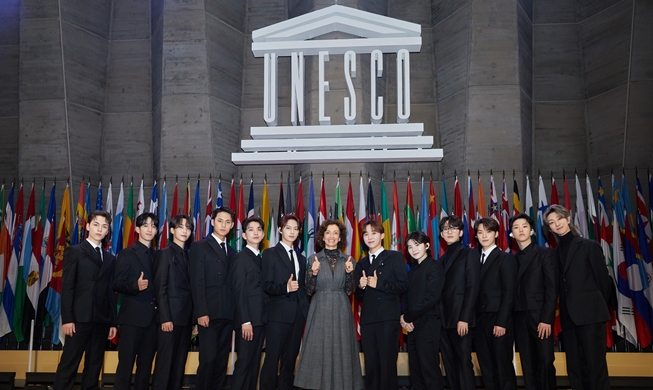
In October 2023, the thirteen-member K-pop group Seventeen was appointed as UNESCO Youth Artist for Peace and designated as a representative of the Republic of Korea to UNESCO, the first K-pop act to hold such a position. At first glance, this may appear to be a straightforward example of cultural diplomacy. However, treating it merely as a symbolic gesture risks overlooking a more complex dynamic at play.
This raises a broader question: why would a state formally integrate a commercial entertainment group into its multilateral diplomatic engagement, particularly within a United Nations body? A more productive interpretation is to view Seventeen’s appointment as part of South Korea’s ongoing effort to stabilize and project a coherent international identity.
Rather than seeing K-pop simply as soft power, this essay argues that it functions as a form of ontological statecraft. Drawing on constructivist theory, particularly ontological security as developed by Mitzen (2006) and refined by von Essen and Danielson (2023), this essay suggests that Seventeen’s UNESCO role reflects South Korea’s attempt to secure recognition as a norm-compliant and globally responsible actor under its Global Pivotal State (GPS) framework.
Ontological security refers to a state’s need for a stable and continuous sense of self, beyond mere physical survival (Mitzen, 2006). States seek consistency in how they understand themselves and how they are recognized by others. When there is a gap between a state’s desired identity and how it is perceived externally, a sense of anxiety or “shame” can emerge. Building on this, von Essen and Danielson (2023) identify multiple mechanisms through which ontological insecurity manifests, shaped by both internal and external dynamics. In the South Korean case, this insecurity is closely tied to what has been described as the “Korea Paradox” (Snyder, 2018). Despite being a major economic power and a successful democracy, South Korea has often struggled to translate this status into equivalent political recognition on the global stage.
In this context, cultural diplomacy has increasingly become one of the arenas through which this gap is addressed. It is not simply about visibility, but about shaping how that visibility is interpreted. Seventeen’s appointment should not be seen in isolation. It is part of a broader pattern in which the South Korean state actively engages with cultural industries to advance its international positioning. What makes this case distinctive, however, is the formal embedding of K-pop within the institutional framework of UNESCO, a key actor within the Liberal International Order. Viewed through an ontological security lens, this move operates across several mechanisms.
First, at the relational level, it addresses the issue of external recognition. South Korea’s claim to cultural significance is not only asserted domestically but validated by an authoritative international institution. UNESCO’s endorsement carries symbolic weight, it transforms cultural success into recognized legitimacy. In this sense, the appointment performs what Mitzen (2006) describes as intersubjective recognition, a crucial component in stabilizing state identity.
Second, at the systemic level, the appointment aligns South Korea’s cultural influence with globally accepted norms. UNESCO’s emphasis on education, peace, and cultural exchange mirrors the normative language of the Liberal International Order. By positioning Seventeen within this framework, South Korea signals that its cultural influence is not purely commercial, but also ethically and normatively grounded. This alignment helps reduce potential tension between market driven cultural production and the state’s self-image as a responsible global actor.
Third, at the reflective level, the appointment contributes to narrative continuity. South Korea’s rapid transformation, from post-war devastation to global cultural prominence, is often celebrated, but it is not without discontinuities. Historical trauma, geopolitical vulnerability, and moments of economic crisis complicate this narrative. In this context, globally recognized cultural figures like Seventeen serve as anchors of continuity. Their success reinforces a story of progress, resilience, and capability that the state seeks to maintain.
Importantly, this is not just about popularity. It is about how that popularity is institutionalized and interpreted. That said, it would be misleading to assume that this strategy is entirely stable or uncontested. Ontological security built through cultural performance remains inherently fragile. One limitation lies in the dependence on audience reception. Global audiences engage with K-pop primarily as entertainment, not as a vehicle of state identity. This creates a degree of unpredictability; shifts in popularity, controversies, or changing cultural trends can quickly undermine the symbolic capital that the state seeks to harness.
There is also a structural tension in relying on private actors. In Seventeen’s case, the group operates under a corporate entity (HYBE), introducing a potential gap between state objectives and corporate interests. The state, in effect, borrows legitimacy from actors it does not fully control. This creates a classic principal-agent problem, where alignment cannot always be guaranteed. These limitations suggest that while cultural diplomacy can contribute to ontological stability, it cannot fully resolve underlying insecurities. It is, at best, a partial and contingent solution.
Seventeen’s appointment as UNESCO Youth Artist for Peace offers more than a symbolic milestone in cultural diplomacy. It provides insight into how South Korea navigates its position in the international system, not primarily through coercion or material dominance, but through the careful construction and validation of identity.
A constructivist perspective helps explain what more traditional approaches cannot, why recognition, legitimacy, and narrative coherence matter so deeply in state behavior. South Korea’s engagement with K-pop, in this sense, is not peripheral to its foreign policy. It is central.
More broadly, this case suggests that for middle powers, influence may increasingly depend not only on what they have, but on how they are perceived. In this context, culture becomes more than a tool of attraction, it becomes a means of managing how a state understands itself and is understood by others.
Writer: Devina Luthfiyana Izzah – 202410360110080
References
Jin, D. Y. (2016). New Korean wave: Transnational cultural power in the age of social media. University of Illinois Press. https://doi.org/10.5406/illinois/9780252039973.001.0001
Mitzen, J. (2006). Ontological security in world politics: State identity and the security dilemma. European Journal of International Relations, 12(3), 341–370. https://doi.org/10.1177/1354066106067346
Nye, J. S. (2004). Soft power: The means to success in world politics. PublicAffairs.
Snyder, S. A. (2018). South Korea at the crossroads: Autonomy and alliance in an era of rival powers. Columbia University Press.
UNESCO. (n.d.). Seventeen: UNESCO goodwill ambassador for youth. https://www.unesco.org/en/goodwill-ambassadors/seventeen
von Essen, H., & Danielson, A. (2023). A typology of ontological insecurity mechanisms: Russia’s military engagement in Syria. International Studies Review, 25(2), viad016. https://doi.org/10.1093/isr/viad016
Yoon, K. (2023). De/constructing the soft power discourse in Hallyu. Communication Research and Practice, 9(3), 1–17. https://doi.org/10.1080/22041451.2023.2237811