
Image source: Google
Behind the Indo Pasific strategy with NATO that was striking by South Korea during the Yoon Suk Yeol administration, there is uncertainty about how this policy will continue considering the inconsistency of motives across different South Korea administration until today. An inresting phenomenon in South Korea’s relationship with NATO is that this cooperation has been deepened by both political camps in Seoul itself, both from progressive dan concervative. The transtition from the pragmatist administration of Moon Jae-In (2017-2022), to the concervative Yoon Suk-Yeol (2022-2024), and then back to pragmatism in the Lee Jae-Myung’s adminitration (2025-now). The exposes the vulnerability of this strategy where the ambiguous relationship is controlled by geopolitical developments rather than national identity, allows us to predict South Korea’s Indo-Pasific foreign policy in the future.
During the Moon Jae In administration, he adopted a foreign policy aimed at reducing tensions on the Korean Peninsula throught dialogue and interaction with North Korea. His policy was carefull to avoid any direct military alignment with NATO that could provoke North Korea and reduce military tensions. In short, the Moon administration’s approach aims to balance South Korea’s security interest by priotizing a peace strategy and positioning the Republic of Korea as a global actor without directly confronting North Korea, China, or Russia.
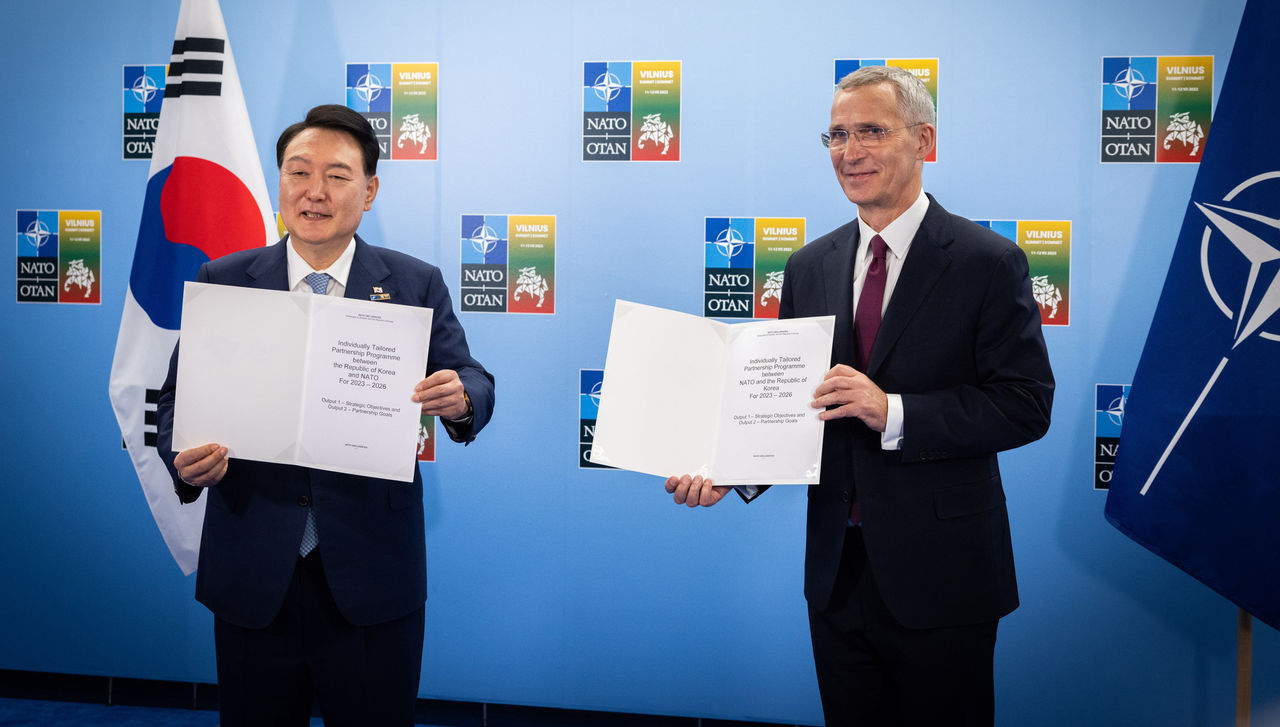
While in the line with the Indo-Pasific strategy, the Yoon Suk Yeol administration announced it vision to become a ‘Global Key Nation’, emphasizing South Korea’s role as an agenda-setter in preserving the liberal international order and relations between the region and the Europe under the Global Key Nation vision. This signified European countries as key partners with shared values including liberalism democracy, and human rights. As part of this , the Yoon administration esthablished a diplomatic mission to the North Atlantic Traety Organization (NATO), consistently participated in the summits, while enhancing South Korea’s cooperation with NATO. South Korea has also demonstrated its ability to export and invest in European and NATO security. According to the Stockholm International Peace Research Institute (SIPRI), South Korea suply 6.5% percent of arms imports to NATO-Europe countries by 2024 (Min, 2026). Overall, Yoon Suk Yeol’s administration reflected a more proactive approach to the military threat from North Kore, while also demonstrating a willingness to counter the growing influence of China and Russia in East Asia. China’s increasing military aggression and Russia’s action in ukraine promted Yoon to strengthen ties with NATO as a strategy to maintain the balance of power the region.
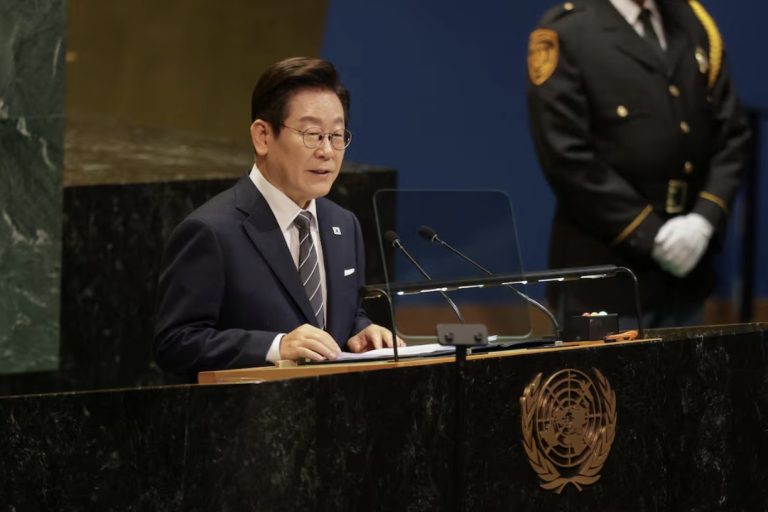
However, the strategy became vulnerable during the current administration Lee Jae Myung transition to a more pragmatic leadership. Lee emphasized that pursuing values, while important, should not be at the absolute expense of South Korea’s national interest and quickly showed his dissent by refusing to attend the 2025 NATO summit. Accoerding to a faction led by National Intelligence Service Director Lee Jong Seok, views the NATO summit as a forum promoting a confrontational international order among major powers. They also worry that Lee’s presence and closer cooperation with NATO will force South Korea to support Ukraine, which contradicts ith pragmatic approach. Lee avoided the uncomfortable situation rhetoric he did not support so as to prioize de-escalation and diplomacy with North Korea, even stating that he valued Moscow as a channel of communication for dialogue with Pyongyang and therefore woulld work to stabilize bilateral relations with Russia.
The ebb and flow of South Korea’s diplomacy with NATO perfectly reflects the Republic of Korea’s struggle to balance the Republic of Korea’s national interest, with policies predicted to continue to change depenting on the election calendar. This proves that Korea’s diplomatic relationship with NATO is highly vulnerable to changes in leadership.
Writer: Nesya Napsiah Zahra – 2024103601101019
References
Ballbach, E. J. (2025). South Korea’s Ever-Closer Relations with NATO. Intersecting and Varying Motives of South Korea’s Moon Jae-in and Yoon Suk-yeol Administrations. https://doi.org/10.18601/16577558.n41.03
Lee, C. M. (2026). Are Long-Term NATO–South Korea Defense Ties Possible? Transitioning From an Arms Exporter to a Trusted Defense Partner. Carnegie. https://carnegieendowment.org/research/2026/02/are-long-term-nato-south-korea-defense-ties-possible-transitioning-from-an-arms-exporter-to-a-trusted-defense-partner
Lee, D. (2025). South Korea moves away from former Indo-Pacific Strategy. East Asia Forum. https://eastasiaforum.org/2025/07/21/south-korea-moves-away-from-former-indo-pacific-strategy/
NATO. (2023). Secretary General welcomes NATO’s deepening partnership with South Korea. North Atlantic Treaty Organization. https://www.nato.int/en/news-and-events/articles/news/2023/07/11/secretary-general-welcomes-natos-deepening-partnership-with-south-korea#:~:text=Secretary%20General%20welcomes%20NATO’s%20deepening%20partnership%20with%20South%20Korea,-11%20July%202023&text=Secretary%20General%20Jens%20Stoltenberg%20welcomed,mission%20to%20NATO%20last%20November.
NATO. (2025). Relations with the Republic of Korea. North Atlantic Treaty Organization. https://www.nato.int/en/what-we-do/partnerships-and-cooperation/relations-with-the-republic-of-korea
Park, J. 2025. Why South Korea’s new president skipped the NATO summit. Responsible Statecraft. https://responsiblestatecraft.org/nato-summit-2672441725/