
Image source: Google
Introduction
South Korea, a state with aunique cultural homogenity that is increasingly popular among the international community, especially Sotheast Asian states. Located between Japan and China in the East Asia, South Korea’s position is never seperated from complex relationship, close economically, yet often tense politically and historically. To this day, the three states remain interconnected in trade and regional security issues, but memories of the past and geopolitical rivalries continue to influence perceptions and policies toward each other.
The historical conflict between South Korea and Japan occurred because of the Japanese textbook which claimed that the colonialization on Korea was an “advancement” instead of “aggression”, this statement led to demonstrations in order to revise the truth. Moreover, Japan’s government responded this issue by changing the actual fact, yet it still controversial because they deleted the “comfot women” issue on the textbook (Hahm & Heo, 2019).
Additionally, the historical claims over Gorguryeo and the dispute ober Leodo marked the tension between Soth Korea and China, where related to maritime boundaries. This dispute was also led to continous demonstration, Some aggressively claimed Koreans’ right to Gojoseon (Old Joseon) and others tried to expand this as part of a territorial claim over Gando (Jiando) through offensive and nationalistic rhetoric(Sin-Cheol, n.d.).
Those diverse conflicts led South Korea’s foreign policy, especially toward Southeast Asian states, which have a huge “Korean lover” community, like K-Pop fans, K-Drama enjoyers, or even daily-beauty enthusiasts. Being an ex-colonalized state, South Korea indirectly refuse any kind of colonialization, that’s why this paper will examine how is South Korea’s historical disputes affect its foreign policies toward Southeast Asian states through on of IR perspectives named “constructivism” in order to know that every action of an actor (South Korea) is socially constructed.
South Korea’s Identity as a Colonialized State
South Korea experienced a long period of colonialization that resulted in human rights violations, limited domestic development, and identity crisis. In response to this historical experience, the state developed an anti-colonial identity and implement this effort both through its domestic and foreign policies. This commitment is executed through the implementation of the Sustainable Development Goals (SDGs) in addressing global inequalities (Park & Park, 2024). South Korea promotes inclusive development, social justice, and greater opportunities for poor residents through this framework. Additionally, the state positions itself as an advocate of international norms that emphasize human rights protection and sustainable development.
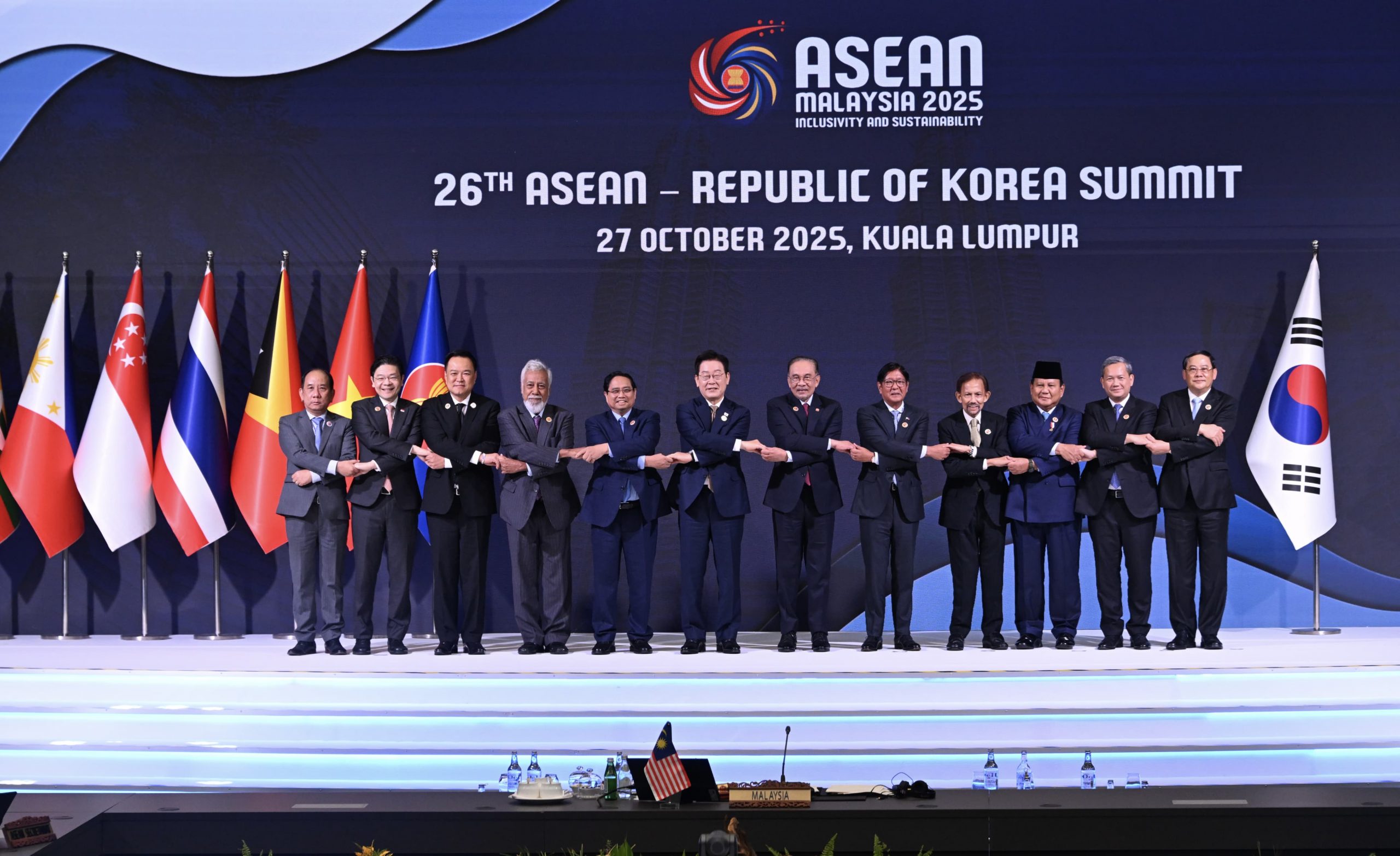
Furthermore, the South Korea’s identity transformation from colonialized state to an active global actor that creates new global aid standards can be seen through partnership pattern toward developing states, rather than patron-client which represents colonialization culture. This approach emphasizes through knowledge transfer and institutional capacity upgrade which possible to create a state to be autonomous economically. Integrating social justice norms, South Korea puts effort to reduce global dependencies. This inclusivity principle is relevant to be implemented toward ASEAN states’ development cooperations, especially after the establishment of Comprehensive Strategic Partnership (CSP) at the 25th ASEAN-ROK summit(ASEAN-Korea Economic Relations – ASEAN Main Portal, n.d.).
South Korea’s SDGs Foreign Policy Implementations toward ASEAN States
The South Korea’s anti-colonialism identity manifestation can be seen through cooperation pattern between this state and Southeast Asian states through SDGs’ implementation, which emphasizes cooperation equal partnership princliple model that respects states’ sovereignty. This approach was born from the historical realization as a same colonialized state, so any kind of aids will be recognized as civil empowerment and development of the social capacity quality. Thus, South Korea is a strategic partner for ASEAN states that try to stop global economic dependency through inclusivity and social justice rather than a financial backer only.
Economically, South Korea has established several cooperations toward ASEAN states, even ASEAN is South Korea’s second largest trading partner with two-way trade volume US $208 Billion in 2022 (Korean Companies Making Waves in ASEAN | UOB ASEAN Insights, n.d.). This agreement can be happened because the large number of South Korea’s cultural consumers in Southeast Asia which become a great opportunity for both side. In other words, this agreement could create many job opportunities for those states that resulted in decreasing the percentage of poverty in the region which is one of the main goals of the SDGs.
Moreover, South Korea is actively promotes educational agreements in order to enhance the quality of educational system, especially within ASEAN states. The 2nd ASEAN-Korea Forum on the Future of Education in 2022 was a great example of this implementation, which these states were discussing about the usage of digital platform that may help top increase the quality of education. Kao Kim Hourn, the Secretary-General of ASEAN argued that the usage of digital technology can make ducation more inclusive and accessible, even though he admitted that this technology remain major challenges (ASEAN Main Portal, n.d.). This agreement proved that South Korea is actively supported the SDGs implementation globally, which is aligned with its ideology in fighting human rights’ violation and promoting global prosperity.
Conclusion
South Korea’s historical disputes with Japan and China played a significant role in shaping its national identity and foreign policy orientation. As a colonized state, South Korea has developed an anti-colonial norm that influences how they act internationally. Using constructivism perspective, this identity explains why South Korea tends to promote equality, prosperity, and inclusive development. This movement can be seen through its relations with developing states, especially Southeast Asian states as their partner.
The global implementation of this identity is realized by South Korea through the realization of the Sustainable Development Goals (SDGs). By strengthening trade relations with ASEAN and promoting initiatives, South Korea contributes to regional development while also fostering mutually beneficial partnerships. These policies explain how South Korea;s historical memory can shape its efforts in promoting inclusive growth, reduce inequality, and support sustainable development in Southeast Asia.
Writer: Adhi Kumara Jagadhita (202410360110022)
Bibliography
2nd ASEAN-Korea Forum on the Future of Education spotlights digital transformation in education – ASEAN Main Portal. (n.d.). Retrieved March 12, 2026, from https://asean.org/2nd-asean-korea-forum-on-the-future-of-education-spotlights-digital-transformation-in-education/
ASEAN-Korea Economic Relations – ASEAN Main Portal. (n.d.). Retrieved March 10, 2026, from https://asean.org/our-communities/economic-community/integration-with-global-economy/asean-korea-free-trade/
Hahm, S. D., & Heo, U. (2019). History and territorial disputes, domestic politics, and international relations: An analysis of the relationship among South Korea, China, and Japan. Korea Observer, 50(1), 53–80. https://doi.org/10.29152/KOIKS.2019.50.1.53
Korean Companies Making Waves in ASEAN | UOB ASEAN Insights. (n.d.). Retrieved March 12, 2026, from https://www.uobgroup.com/asean-insights/articles/south-korean-companies-making-waves.page
Park, K. R., & Park, Y. S. (2024). Addressing institutional challenges in sustainable development goals implementation: Lessons from the Republic of Korea. Sustainable Development, 32(1), 1354–1369. https://doi.org/10.1002/sd.2725
Sin-Cheol, L. (n.d.). Korea-China-Japan Historical Disputes: Structure and Alternatives.