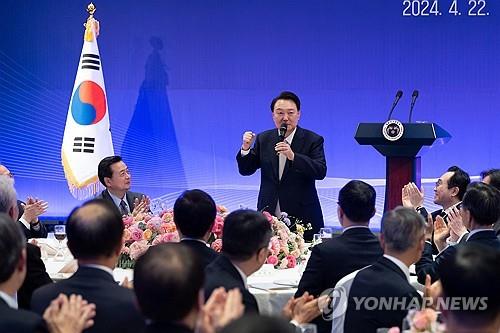

Image source: Yonhap News Agency (en.yna.co.kr)
At the end of the Korean War in 1953, South Korea’s economy was shattered. Under Park Chung-Hee’s coup, with assistance from the IMF, the country recovered from the crisis relatively quickly and repaid the IMF’s package ahead of schedule. The economy grew, and massive corporations were founded through large-scale investment in export-relevant industries alongside protectionism for the domestic market. South Korea was classified as a recipient of development assistance until 1990 (Olbrich, P., & Shim, D., 2012). At the end of the Cold War, even though South Korea displayed some middle power characteristics, it was following a recovery from the Asian Financial Crisis, and in the early 2000s, the country joined the ranks of the middle powers and fully cemented its developed country status (Pardo, 2023).
In late 2009, President Lee Myung-Bak launched the “Global Korea” Strategy to promote Korea’s development assistance activities (Olbrich, P., & Shim, D., 2012), The idea of “Global Korea” was then reformed by President Yoon Suk-Yeol as “Global Pivotal State”, a foreign policy strategy that embraces greater roles and responsibilities for resolving regional and global challenges in the Indo-Pacific region and beyond. South Korea’s GPS aims to make its country more central to global affairs. In this respect, South Korea actively pioneers major Global Institutions, including the UN, G20, and OECD (Pardo, 2023).
Since 1996, South Korea has been a member of the Organization for Economic Cooperation and Development (OECD), and in late 2009, it was promoted to the Development Assistance Committee of the OECD. South Korea, which was formerly considered a recipient country, has become an aid donor state as it is one of the three largest Asian donors and the top two largest spenders in innovation among OECD countries, along with Israel. The South Korean economy has recently been driven by innovation at the frontier, and the country’s firms are among the world’s leaders. Thus, South Korea became one of the ten largest exporters of merchandise goods in the world, a position that it still retained at the end of 2021.
South Korea has also been a member of the G20, a group that leads the economies and promotes financial stability, has been invited to partake in G7 Summits, and in 2010, South Korea’s leadership was entrusted to host the G20 Seoul Summit, which further elevated its status as a middle power capable of influencing global economic decision-making. Then in 2013, it launched MIKTA, a coalition of middle powers also involving Mexico, Indonesia, Turkey, and Australia. Furthermore, South Korea is one of the four Asia-Pacific countries with which NATO is strengthening links within the NATO-AP4 framework, along with Australia, Japan, and New Zealand, whose leaders attended the 2022 NATO Summit in Madrid. (Pardo, 2023)(Khudiyeva & Vagnini, 2025). In strengthening its role as a middle power, South Korea acted as a bridge-builder and niche-diplomacy on the G20 forum. From these efforts, we could see that South Korea had been trying to create economic stability and ensure fair global competition among the G7 countries.
Beyond economic power, South Korea’s UN membership in 1991 opened the door for Seoul to become a more active player in global affairs. South Korea has become a keen supporter of the UN system, most notably with Ban Ki-moon’s tenure as Secretary General of the UN in 2007-16. From the late 2000s, South Korea also found a niche area in sustainable development and green growth. As three cases in point, the UN opened its Office for Sustainable Development (UNOSD) in Incheon in 2011, the Green Global Growth Institute (GGGI) was launched in Seoul in 2012, and South Korea was one of the founding partners of Partnering for Green Growth and the Global Goals 2030 (P4G) in 2017. Another area in which South Korea has also found a niche is peacekeeping. Seoul is one of the ten largest contributors to the UN’s peacekeeping budget, and in 2021 hosted the Seoul UN Peacekeeping Ministerial. These are two examples of issue areas in which South Korea has become an authoritative voice and player in recent years (Pardo, 2023).
In conclusion, the current status of South Korea shows its manifestation and ambition to take more responsibility in the international community, by integrating economic power, niche diplomacy, and leadership toward International Institutions. South Korea has strengthened its position as a central actor in addressing regional and global challenges in the future.
Writer: Muhammad Aufa Rafiqi – 202410360110020
Sources
Pardo, Ramon Pacheco (2021). From Shrimp to Middle Power to Something More? South Korea as a Global Pivotal State. Korea Economic Institute of America, 32(3), 167–186.
Khudiyeva, S., & Vagnini, A. (n.d.). The role of globalization in shaping South Korea’s foreign policy: a historical analysis.
Olbrich, P., & Shim, D. (2012). South Korea as a global actor: international contributions to development and security. (GIGA Focus International Edition, 2). Hamburg: GIGA German Institute of Global and Area Studies – Leibniz-Institut für Globale und Regionale Studien. https://nbn-resolving.org/urn:nbn:de:0168-ssoar-309707
Yeo, A. (2023, December 19). South Korea as a global pivotal state. Brookings. https://www.brookings.edu/articles/south-korea-as-a-global-pivotal-state/