
Image source: Several sources
Introduction
South Korea has transformed dramatically over the past seven decades, rising from the ashes of war to become one of the world’s most advanced economies and a global cultural trendsetter. Yet beneath this success story lies a lesser-known reality: the presence of a Muslim minority in one of the most ethnically homogeneous countries on earth. Today, about 250,000 Muslims live in South Korea, roughly 0.3 to 0.5 percent of the population (Arab News, 2025a). This community’s journey offers a unique window into how religious minorities navigate a society long defined by ethnic and cultural homogeneity. This essay examines the historical roots, demographic composition, challenges, and opportunities of South Korea’s Muslim community. I argue that this minority serves as an important case study for understanding the tension between ethnic nationalism and multiculturalism, revealing both the difficulties and the possibilities of building a more inclusive society in a globalizing world.
Discussion
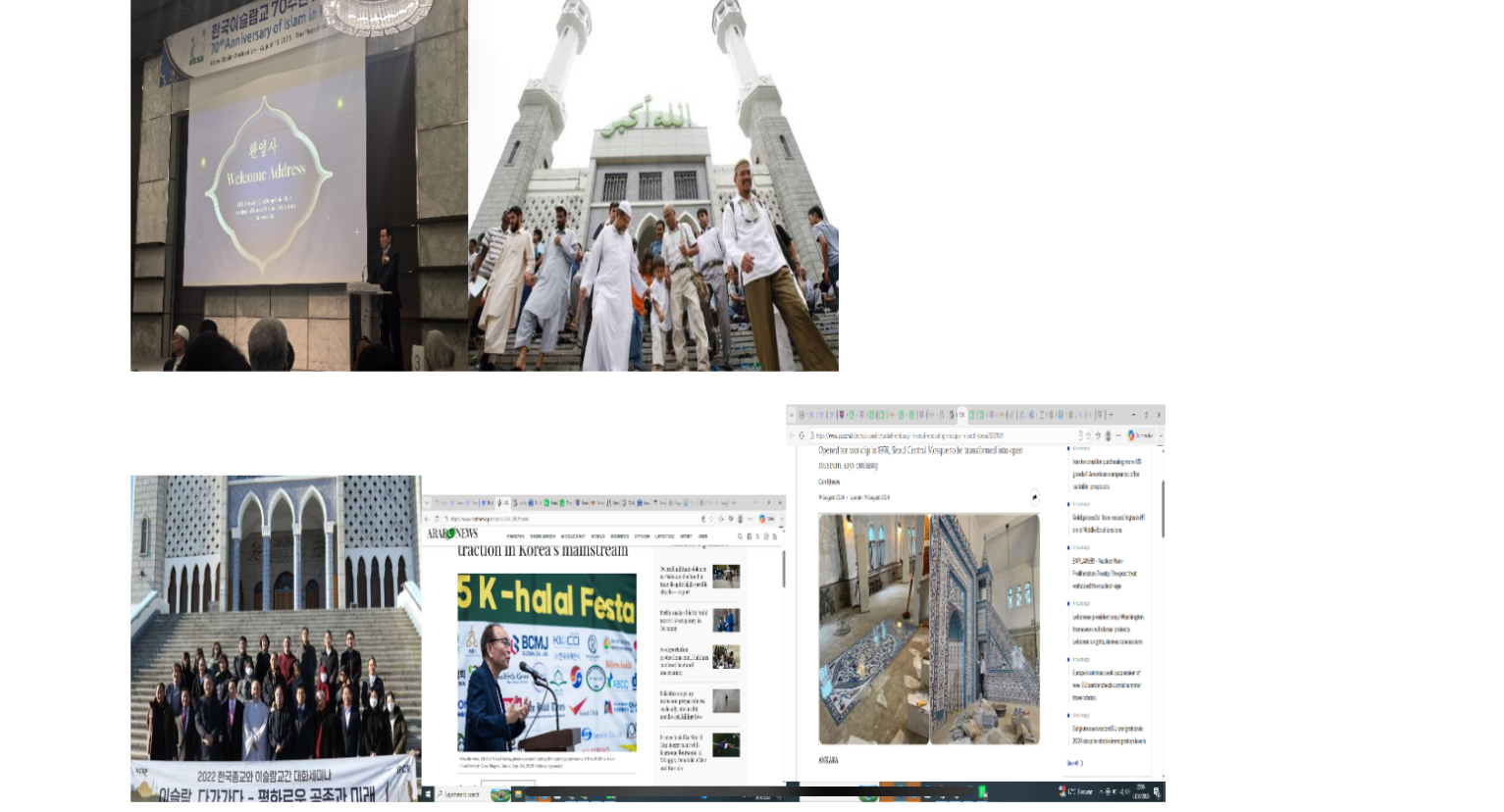
Islam’s connection to Korea stretches back centuries. Arab merchants traded with the Silla Kingdom as early as the ninth century (The Korea Times, 2025), but the faith only took root during the Korean War (1950-1953), when roughly 4,500 Turkish soldiers serving with United Nations forces introduced Islamic practices while aiding war orphans (The Korea Times, 2025). Their compassion left a lasting impression: in 1954, more than two hundred Koreans converted, forming the Korea Muslim Society in 1955, later renamed the Korea Muslim Federation in 1967 (Anadolu Agency, 2024). A major milestone followed in 1976 with the Seoul Central Mosque, funded by Saudi Arabia on land donated by the government (Arab News, 2025a). Today the country has twenty-four mosques and more than 260 prayer spaces (The Korea Times, 2025).
The community is far from uniform. Foreign workers from Indonesia, Pakistan, Bangladesh, and Uzbekistan make up roughly 70 percent, employed mainly in factories and farms (Arab News, 2025a). Korean converts number between thirty-five and seventy thousand, alongside about 150,000 foreign Muslims (Lee, 2024). Korean converts face a double exclusion: seen as outsiders for their religion yet fully Korean by ethnicity. As Eom Min-a, a government worker, put it, being Muslim in South Korea can feel “a lonely and alienating experience” (Arab News, 2025a).
Everyday life brings serious obstacles. South Korea’s heavy drinking culture, woven into business and social life, creates friction for abstaining Muslims, alongside subtle discrimination and a persistent sense of not belonging (Arab News, 2025a). Mosques are concentrated in large cities, leaving rural Muslims with few options, and halal food remains scarce outside Itaewon’s “Muslim Street.” Certification is inconsistent, and as Kim Jin-woo noted, most South Koreans do not even know what halal means (Arab News, 2025b). Scholars describe Korea’s multiculturalism as conditional, “sustaining inclusion without equality and recognition without acceptance” (Mohd Ghazi et al., 2025).
Yet the community also creates opportunity. The global halal market is projected to reach USD 2.72 trillion by 2025, and halal products already made up 11.1 percent of Korea’s agricultural and food exports in 2023 (Arab News, 2025b). In early 2025 the government expanded halal certification bodies from four to six (Arab News, 2025b). Cultural exchange has grown too: during Ramadan the Seoul Central Mosque becomes a gathering place for Muslims and curious non-Muslims alike, the Korea Muslim Federation has published a Korean Quran translation (The Korea Times, 2025), and the Turkish Embassy’s renovation project aims to turn the mosque into an “open museum” for cultural diplomacy (Anadolu Agency, 2024).
Several theories illuminate this situation. Multiculturalism theory highlights the struggle for recognition in a society long defined in ethnic terms; Korean Muslims have pursued “integration without assimilation” rather than abandoning their faith. Social capital theory explains how mosques and community groups build support networks: Kim Jin-woo described the mosque as feeling “like home… In our heart, it is a place like home” (Arab News, 2025a), and such networks are vital for migrant workers seeking housing, jobs, and legal help. Transnationalism theory shows how the community stays linked to home countries and the global Muslim world through Hajj and international gatherings (Arab News, 2025b), sustaining access to religious knowledge even while living in Korea.
In my view, South Korea’s Muslim community should be seen as an asset rather than a burden, contributing labor while bridging Korea and the Islamic world. Real integration, however, needs more than economic contribution: it requires social acceptance and institutional support. The government could simplify halal certification, build mosques in underserved areas, and include Islam in school curricula and public campaigns. Korean society needs to move from mere tolerance to genuine inclusion, recognizing that diversity strengthens rather than weakens national identity.
Conclusion
Though small in number, South Korea’s Muslim community offers an important test of the country’s commitment to religious and cultural diversity. From its beginnings during the Korean War to today’s mix of migrants, converts, and professionals, Korean Muslims have shown resilience in holding onto their faith (The Korea Times, 2025). The challenges they face, cultural friction, limited facilities, halal scarcity, and public ignorance, reflect broader tensions between ethnic uniformity and growing multiculturalism. Yet the opportunities their presence creates, from the halal economy to cultural exchange, suggest this community is a national asset (Arab News, 2025b). As South Korea navigates a changing world, its Muslim minority’s experience offers valuable lessons for building a more open and inclusive society.
Writer: I Gede Budi Artawan – 202410360110117
References
Anadolu Agency. (2024, August 19). Turkish Embassy in Seoul renovating mosque in South Korea. https://www.aa.com.tr/en/asia-pacific/turkish-embassy-in-seoul-renovating-mosque-in-south-korea/3307801
Arab News. (2025a, January 22). In Itaewon, Seoul’s Korean Muslim minority finds a sense of belonging. https://www.arabnews.pk/node/2587396/world
Arab News. (2025b, September 22). Once overlooked, K-halal gains traction in Korea’s mainstream. https://www.arabnews.pk/node/2616286/thesix
Lee, H.-r. (2024, April 17). Korean Muslim YouTuber to build mosque in Incheon. The Korea Times. https://www.koreatimes.co.kr/southkorea/society/20240421/korean-muslim-youtubers-plan-to-build-mosque-in-incheon-unravels
Mohd Ghazi, A. F. N., Jamil, A. M., Mohd Ghazi, A. F., & Karaman, M. S. (2025). Rethinking multiculturalism in a homogeneous society: A qualitative inquiry into Muslim integration in South Korea. Advances in Humanities and Contemporary Studies, 6(2), 253–265. https://publisher.uthm.edu.my/periodicals/index.php/ahcs/article/view/21823
The Korea Times. (2025, August 14). Korea Muslim Federation celebrates 70 years of Islam in Korea. https://www.koreatimes.co.kr/foreignaffairs/20250814/korea-muslim-federation-celebrates-70-years-of-islam-in-korea