
Image source: Yonhap (Korea JoongAng Daily)
Introduction and Problem Statement
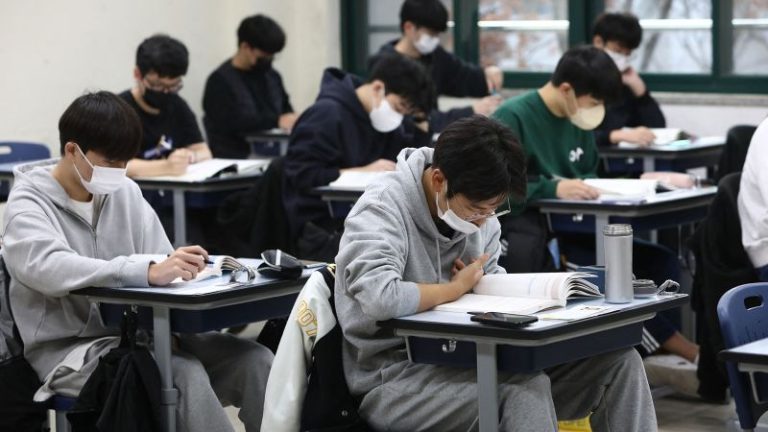
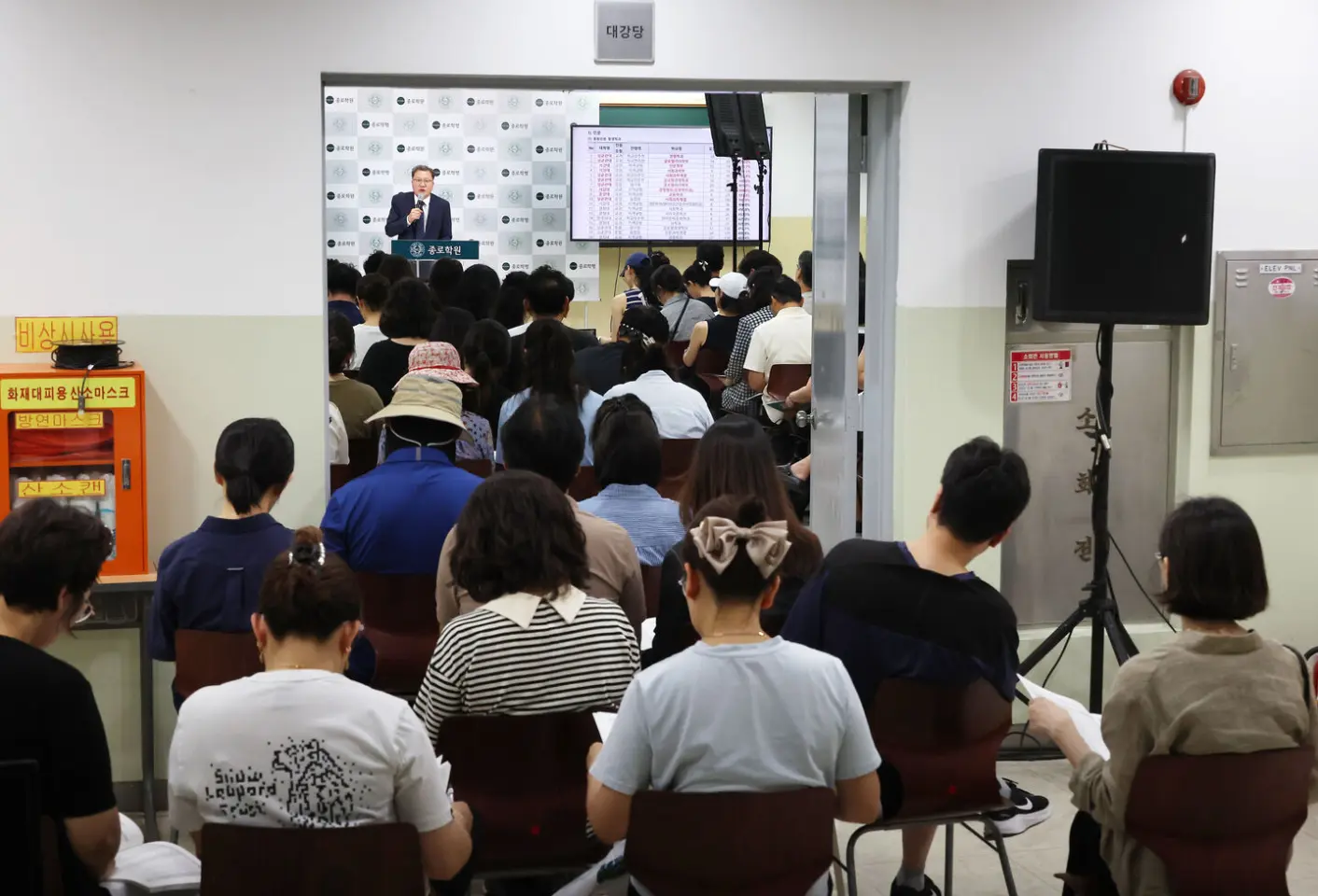
South Korea is widely recognized for its rapid economic development and global cultural influence, but this success masks a profound domestic struggle. At the foundation of its society lies an education system defined by intense, relentless competition, which culminates in the high-stakes national university entrance exam known as the Suneung. The primary problem is that this hyper-competitive academic environment imposes an unsustainable psychological and financial burden on the population. To secure a successful future, students are expected to spend countless hours after regular classes in expensive private tutoring centers called hagwons. This grueling routine forces teenagers to sacrifice essential sleep, physical health, and personal development for test preparation, resulting in a severe youth mental health crisis marked by high rates of stress and depression. Simultaneously, the staggering financial cost of mandatory private education has made raising children prohibitively expensive for average families.
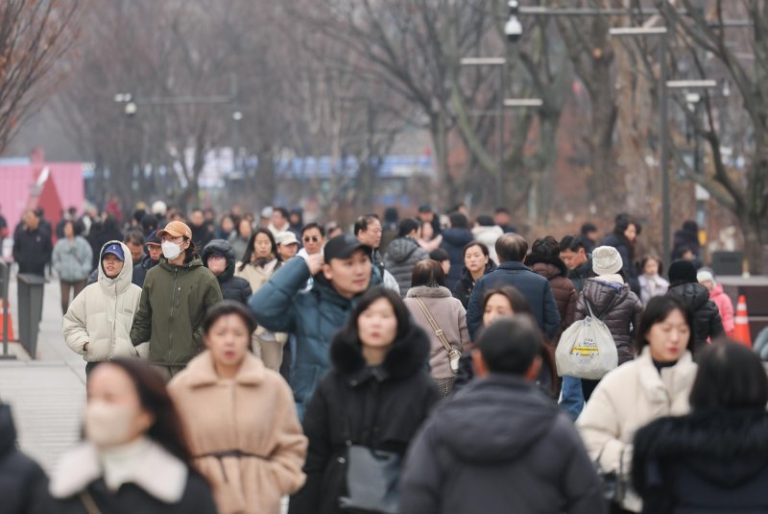
Addressing this educational crisis is critically important because it directly threatens the long-term survival of the nation. The immense pressure of the schooling system is routinely cited as a leading cause of South Korea’s collapsing birth rate, which is currently the lowest in the world. Young couples are increasingly refusing to start families to spare themselves and their potential children from this grueling cycle. If the structural issues within the education system are not resolved, South Korea faces irreversible demographic decline, a shrinking labor force, and an unsustainable social safety net.
Issue analysis and opinion
To understand why South Korea’s education system has become a source of profound societal distress, it is helpful to examine the issue through the lens of Developmental State Theory. This theory describes a model of governance where the government takes a remarkably strong, interventionist role in guiding macroeconomic development. Instead of leaving the market to operate freely, a developmental state actively plans, manages, and directs resources to specific industries to achieve rapid industrialization. Following the devastation of the Korean War, South Korea aggressively adopted this approach. The government partnered with massive family-owned conglomerates, known as chaebols, to transform the country into an export-driven global powerhouse in record time. In this developmental state framework, education was never solely about individual enlightenment or personal growth. Instead, it was mobilized as a highly efficient tool for national economic survival. The state urgently required a massively educated, strictly disciplined workforce to fuel its rapid industrial expansion and technological advancement. Consequently, the national education system was engineered to sort, rank, and allocate human capital efficiently. The national university entrance exam, or Suneung, was established as the ultimate sorting mechanism. It was designed to filter the highest-performing students into elite universities, effectively guaranteeing them secure, well-compensated positions within the state-backed chaebols.
Today, the phenomenon of the hyper-competitive education system and the mandatory reliance on private hagwons is a direct hangover of this state-led developmentalism. While South Korea has successfully transitioned into a wealthy, advanced democracy, the structural bottlenecks created by its developmental past remain deeply entrenched. The modern labor market is still starkly polarized between a small number of lucrative, prestigious roles at major conglomerates and less secure, lower-paying jobs at smaller enterprises. Because the developmental state inextricably linked academic ranking to lifelong economic security, the Suneung is viewed as a high-stakes battle for survival. Families pour their financial resources into private tutoring because failing the exam means falling behind in a highly stratified society that offers a relatively weak social safety net for those outside the top economic tier.
Approaching this issue from an International Relations and international political economy perspective reveals a fascinating, albeit tragic, structural paradox. A nation’s standing on the global stage, particularly for a middle power navigating the complex geopolitics of East Asia, relies entirely on its economic vitality, technological innovation, and diplomatic influence. Historically, South Korea brilliantly leveraged its highly educated human capital as its primary geopolitical asset to secure its position in the global hierarchy. However, the exact domestic structures that built this remarkable international power are now actively cannibalizing its future. The relentless, state-engineered pressure of the education system is steadily eroding the country’s foundation from the inside. When the immense financial and psychological cost of producing competitive human capital results in the lowest fertility rate in the recorded world and a devastating youth mental health crisis, the traditional developmental model transitions from a strategic asset into a severe security vulnerability. A middle power simply cannot sustain its diplomatic influence, its global supply chain dominance, or even its essential military readiness without a stable, resilient population. Therefore, this domestic educational struggle is much more than a localized social hardship. It represents a critical, existential threat to South Korea’s long-term international security and its capacity to maneuver within the broader global political economy. Ultimately, a state cannot project sustained power abroad while its society collapses under the weight of competition at home.
Conclusion
In conclusion, South Korea’s hyper-competitive education system is a tragic legacy of its developmental state era. While this intense model successfully built a global economic powerhouse, the resulting psychological and financial burdens now actively threaten the nation’s demographic survival and international security. To resolve this existential crisis, the government must decouple lifelong economic security from a single exam. The primary solution requires structural labor reform to reduce the stark wage gap between elite chaebols and smaller enterprises. Furthermore, decentralizing economic opportunities away from Seoul will lower university admission stakes, helping restore a sustainable, healthier society.
Writer: Fachri Faruq Firdian – 202410360110108
References:
A scoping review of occupational imbalance among Korean high school students. (n.d.). PubMed Central (PMC). https://pmc.ncbi.nlm.nih.gov/articles/PMC13090154/
Chosun Biz. (2026, June 7). South Korea launches first detailed youth mental health survey of 60,000. https://biz.chosun.com/en/en-science/2026/06/07/JQFS6ZY4CRCZNKADRMPWDUIBSM/
Korea JoongAng Daily. (2026). Private education spending for grade school students hits record high in 2025. https://www.koreajoongangdaily.com/korea/private-education-spending-for-grade-school-students-hits-record-high-in-2025/12560246
Seoul Economic Daily. (2026, April 8). Korea private education spending per student hits record high. https://en.sedaily.com/finance/2026/04/08/korea-private-education-spending-per-student-hits-record