
Image source: Yonhap
In South Korea, ‘no kids-zones’ have been so popular in recent years. This policy aimed at ensuring disturbance-free environments for the grown-ups. First surfacing in 2014, no-kids zones are policies implemented by individual public commercials, typically independent cafés and restaurants –that prohibit the entry and use of their businesses by children under certain ages, usually toddlers and preschool children but possibly even those as old as teenagers (Choi & Lee, 2024). Some people support the business owners’ decision to implement this kids-free zone policy because they complained about certain parents who fail to supervise their unruly child in public spaces (Min-Kyung, 2023).
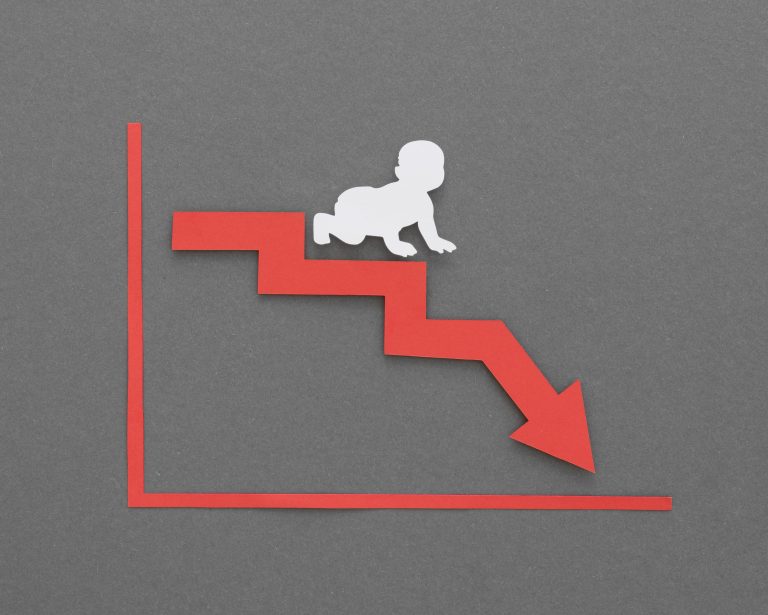
On one hand, the South Korean Government is now facing a national crisis in birth rates that only touches 0.7%, making South Korea the lowest in the world. Based on data, the proportion of citizens aged under 14 years keeps decreasing and the proportion of middle-aged citizens increases and most of them chose not to have children, this would threaten demographic extinction. Responding to the situation, the South Korean Government has made various efforts such as boosting parental leave allowances, lengthening time off for fathers, instituting flexible employment schedules, and lightening the educational hardship on parents (Kreimer, 2024). On the other hand, social phenomena are moving in opposite directions, Jeju Research Institute stated that in 2023 there are more than 542 public commercials that have adopted No Kids Zones (Oaten & Lee, 2023). This contradiction creates discrimination for parents and children in a civil society. No Kids Zones are not merely a matter of public convenience, but a manifestation of exclusion culture that hampers national regeneration and weakens South Korea’s National Power in the East Asian Region.
Zlatko Isakovic in Theory of Political Power in International Relations argued that population is the element of National power. South Korea’s demographic issue is now at its lowest position. A decreasing population means a shrinkage of the domestic market and a chronic labor crisis that could paralyze South Korea’s Economy itself. So, the business owners’ decision to create comfortable public space for customers is not entirely correct, it threatens the future and will slowly weaken the country’s economy.
Furthermore, the expansion of no-kids zones reflects Korea’s social realities that construct the identity of public space. People will define public space as an area that must be sterile, quiet, and productive. Within this perception, the presence of children is often perceived as a disturbance to public convenience. So it means that children are discriminated against in a competitive adult space (Choi & Lee, 2024).
This social pressure is intertwined with the hard economic burden faced by the younger generation. As public spaces transform into a hostile environment, the perception of young Koreans is convinced that becoming parents is a “disadvantageous choice” socially and financially. They would fear social exclusion when bringing children to public areas (Min-Kyung, 2023).
This condition reflects the low social capital, particularly in terms of tolerance and trust among civil society. A society will lose its foundation and stability if it cannot integrate its children into shared space. Without strong social capital, National Power will collapse, and the existential crisis currently faced by the country is getting worse.
The global phenomenon of Hallyu (the K-Wave) as South Korea’s soft power, from the K-Pop dominance in global song charts until Korean cinema achievements at the Oscars, will only become a fruitless effort if South Korea fails to resolve this domestic crisis. Soft Power is an instrument of Influence, but population is the engine that drives it. Without a succeeding generation to maintain the creative and economic ecosystem, Korean cultural glory risks becoming an “inhabitant-less monument” in the future.
The future of South Korea is no longer determined entirely at foreign diplomatic tables or through military alliances, it is determined within the inclusivity of the cafes or other public spaces. The nation’s success in maintaining its national power depends on its society’s ability in redefining public space. If a nation is no longer able to welcome the presence of children in their own daily lives, that is actually practicing the “exclusion of the future’’. We need to recall a quote, “Children are, in fact, the future of a nation”.
Writer: Muhammad Aufa Rafiqi – 202410360110020
Blinliography
.Oaten, James, & Lee, Sookyoung. (2023, 2 Desember). Inside South Korea’s “child-free zones” and the debate over their impact on the world’s lowest birth rate. ABC News. https://www.abc.net.au/news/2023-12-02/inside-south-korea-child-free-zones/103139230
Min-Kyung, Jun. (2023, 11 May). No-kids zones under fire as Korea fights low birth rate. The Korea Herald. https://www.koreaherald.com/article/3144160
Boom Campaign. (n.d.). South Korea’s “No Kids Zones”. https://www-boomcampaign-org.translate.goog/p/south-koreas-no-kids-zones?_x_tr_sl=en&_x_tr_tl=id&_x_tr_hl=id&_x_tr_pto=tc
Choi, Meera, & Lee, Youngco. (2024). Spatial politics of exclusion: No-kids zones in South Korea. Gender, Place & Culture. https://doi.org/10.1080/0966369X.2024.2396879
Kwon, J., & Hollingsworth, J. (2023, 24 June). South Korea’s “no-kids zones” are under fire as the country struggles with a record-low birth rate. CNN. https://edition.cnn.com/2023/06/24/asia/south-korea-no-kids-zone-intl-hnk-dst
Lynch, C., & Silver, H. (2024, 5 February). South Korea’s plan to avoid population collapse. Think Global Health. https://www.thinkglobalhealth.org/article/south-koreas-plan-avoid-population-collapse
Ryu, S. (2023). Discourses on “no-kids zones” in South Korea: Analysis of news articles and social media. Journal of Open Humanities Data, 9(12). https://doi.org/10.5334/johd.123
United Nations Statistics Division. (2026). Total fertility rate – South Korea [Dataset]. UN Data Portal. https://data.un.org/Data.aspx?q=South+korea&d=PopDiv&f=variableID%3A47%3BcrID%3A408%2C410%2C710%2C728%2C920%2C921%2C931