
Image source: Winton (www.dojeonmedia.com)
To this day, academic pressure remains a crucial issue in South Korea. The country’s obsession with education is rooted in the overwhelming ambition to enter a prestigious university. From an early age, children are taught that graduating from a tom university is the ultimate goal and a guarantee of a stable ad high status career. In The Life of IMF Kids, Ahn Eun-byul describes how parents in South Korea relentlessly push their children academically. This behavior stems from the belief that extreme pressure is an essential form of preparation for facing the harsh and uncertain realities of the world. As a result, today’s young Koreans spend the majority of their time at private tutoring centers (hagwon), bear the burden of massive exam pressures, and are forced to sacrifice their childhood happiness in pursuit of academic achievement. This phenomenon is reflected in data showing that approximately 47.6 percent of South Korean children under six have attended private tutoring. Before they can even form a complete sentence, children are already being prepared for collage entrance exams (Jeon, 2025). Meanwhile in high school, sacrificing sleep, personal interest, and mental health to achieve high scores on the Suneung (College Academic Ability Test / CSAT) is commonplace.
This situation is suspected to be one of the triggers for high suicide rate in South Korea, which currently ranks highest among OECD members countries, with a record of around 13,000 deaths in 2022. Contrary to the declining global trend, the suicide rate in South Korea has nearly doubled in the past two decades. Based on 2023 data from the Ministry of Data and Statistics of South Korea, when viewed by education level and employment status, the tendency to have suicidal thoughts is more common among high school graduates, the unemployed, university students, and then housewives.
Most observers tend to simplify the phenomenon of extreme competition in South Korea as a legacy of local Confucian culture that highly values academic status. However, this perspective is considered to ignore macro dynamics that actually have more devastating impact. In reality, this behavioral pattern persist not merely because of past cultural factors, but is driven by the demands of global system that is gradually shaping and dictating the direction of South Korean society’s development. The high level of academic pressure in the country should be critically analyzed as the result of structural changes stemming from South Korea’s full integration into global capitalism following the 1997 Asian Financial Crisis.
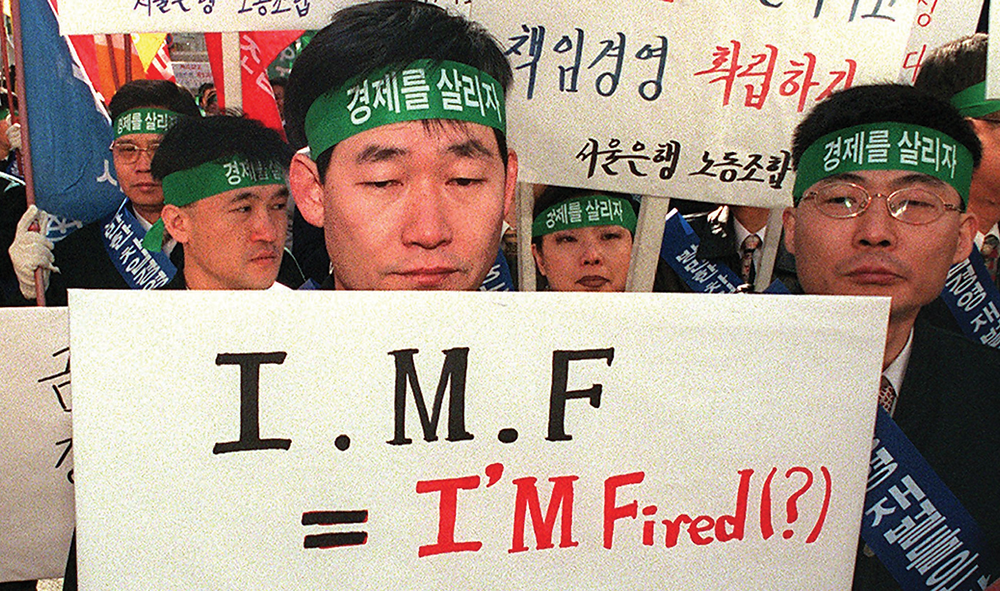
On the verge of bankruptcy, the South Korean government accepted an emergency economic rescue program, forcing it to request $60 billion in financial assistance from the International Monetary Fund (IMF) in December 1997. This financial assistance was provided on the condition that Seoul implement comprehensive neoliberal reforms in accordance with the IMF’s blueprint. The scope of this radical restructuring included a total overhaul of the labor market, the financial sector, public corporations, and the corporate governance system (Yeong-Shin, 2013). The IMF’s intervention policies in 1997 explicitly outlined a strategy based on three main pillars: a firm and clear exit policy, market discipline, and strict oversight, and an enhanced competitive environment (IMF, 1997). These demand forced the South Korean government, particularly under the leadership of Kim Dae-Jung (1998-2003), to enact regulations that made it easier for corporations to carry out mass layoffs in the name of economic efficiency.
To navigate this new high-pressure economic reality, South Korea’s large family-controlled business group known as chaebol (재벌, giant conglomerates such as Samsung, LG, Hyundai, etc) have aggressively shifted their strategic focus to achieving profitability rather than merely expanding business volume. This shift has had a massive impact on employment. Whereas chaebols previously guaranteed lifetime jobs and stable incomes for their their employees, now contract work, part-time work, and outsourcing are becoming increasingly common. The restructuring practices ultimately erode and destroy the job security enjoyed by the middle class.
This vulnerability triggered a significant cultural shift in Korean society, which scholars have described as the “philosophy of the beggar” (걸인의 철학). This philosophy emphasizes that material wealth provides the ultimate security against intimidation. It was this national trauma that drove society to adopt a culture of brutal competition (Yoon, 2025). As economic restructuring eliminated the guarantee of lifetime employment, a collective trauma emerged in the form of a systemic fear of poverty and social class decline. Under the constraints of this system, society was forced to adopt a neoliberal subjectivity, in which the state washed its hands of responsibility and each individual was required to take charge of their own economic fate. As a result, this structural anxiety has seeped into the domestic sphere and redefined the function of education. Schools are no longer viewed as a noble tool for upward mobility, but purely as an instrument of economic defense. This is the root cause of the transmission of a culture of hyper-competition and extreme academic pressure among South Korea’s current younger generation.
Writer: Nesya Napsiah Zahra – 202410360110109
REFERENCE
Data and Statistics Research Institute. (2023). (Health) Suicide Trends and Responses in Korea. Ministry of Data and Statistics. https://mods.go.kr/board.es?mid=b10104000000&bid=12046&act=view&list_no=432657&tag=&nPage=1&ref_bid=
Paul, D. (2025). The Real Story Behind the IMF Crisis Shown in the K-Drama “Typhoon Family”: What Really Happened in Korea in 1997? Dojeon Media. https://www.dojeonmedia.com/post/the-real-story-behind-the-imf-crisis-shown-in-the-k-drama-typhoon-family-what-really-happened-in
Espinosa, C. (2025). Suicide in South Korea – statistics & facts. Statista. https://www.statista.com/topics/8622/suicide-in-south-korea/#topicOverview
International Monetary Fund. (1997). Press Release: IMF Approves SDR 15.5 Billion Standby Credit for Korea. https://www.imf.org/en/news/articles/2015/09/14/01/49/pr9755
Jeon, S. (2025). South Korea’s Education Obsession Is a National Emergency. The Diplomat. https://thediplomat.com/2025/06/south-koreas-education-obsession-is-a-national-emergency/
Kim, K. (2025). South Korea’s escalating early education fever. East Asia Forum. https://eastasiaforum.org/2025/04/26/south-koreas-escalating-early-education-fever/
Organization for Economic Co-operation and Development. (2025). Education at a Glance 2025: Korea. https://www.oecd.org/en/publications/education-at-a-glance-2025_1a3543e2-en/korea_252c9ed2-en.html
Park, G. S. (2004). Economic restructuring and social reformulating: The 1997 financial crisis and its impact on South Korea. Development and Society, 33(2), 147-164. https://s-space.snu.ac.kr/handle/10371/86665
Shin, K. Y. (2013). Economic crisis, neoliberal reforms, and the rise of precarious work in South Korea. American Behavioral Scientist, 57(3), 335-353. https://www.researchgate.net/publication/258122975_Economic_Crisis_Neoliberal_Reforms_and_the_Rise_of_Precarious_Work_in_South_Korea
Yoon, J. (2025). The IMF Crisis and South Korea’s Hyper-Competitive Childhood. https://www.jiwon-yoon.com/the-imf-crisis-and-south-koreas-hyper-competitive-childhood/