
Image source: Google
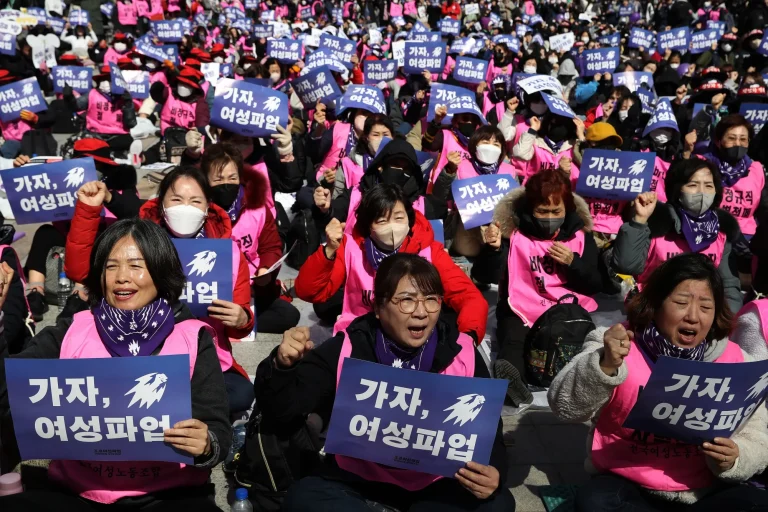
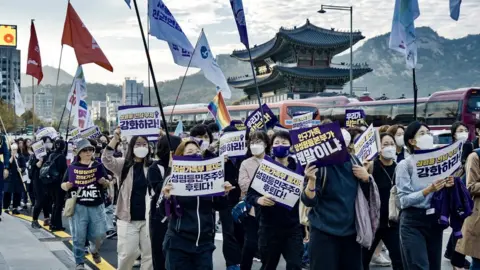
Gender inequality in South Korea appears in many parts of daily life, especially in employment and family responsibilities. According to the OECD, South Korea records the largest gender pay gap among member countries. Women also face fewer opportunities to reach senior positions and often experience career interruptions after marriage or childbirth. Many employers still expect women to take primary responsibility for childcare, while men are expected to focus on paid work. These expectations come from traditional gender norms influenced by Confucian values, which place men as the main breadwinners and women as caregivers. Although the government has introduced laws and policies to improve gender equality, social attitudes have changed more slowly. As a result, many women continue to face unequal treatment in the workplace and carry a heavier burden at home, making it difficult to balance career and family life.
Gender inequality in South Korea appears in many parts of daily life, especially in employment and family responsibilities. According to the OECD, South Korea has the largest gender pay gap among OECD member countries. Women also have fewer opportunities to reach senior positions and often experience career interruptions after marriage or childbirth. Many employers still expect women to become the main caregivers, while men are expected to focus on paid work. This situation limits women’s career development and income. Although more women complete higher education and enter the labor market, equal opportunities in the workplace remain difficult to achieve.
Many of these inequalities are linked to traditional gender norms rooted in Confucian values. For many years, society viewed men as breadwinners and women as caregivers. These expectations continue to influence hiring decisions, promotion opportunities, and the division of household work. The South Korean government has introduced several policies to reduce gender inequality, including employment protection and family support programs. Even so, social attitudes have changed more slowly than formal policies. Many women still carry most childcare and household responsibilities while trying to maintain full-time careers. This gap between policy and everyday practice shows why gender inequality continues to shape social and economic life in South Korea.
Feminist International Relations Theory provides a useful framework for understanding this issue. The theory argues that institutions and public policies often reflect unequal gender relations instead of treating men and women equally. In South Korea, traditional gender norms continue to influence the labor market, family life, and public policy. These structural inequalities reduce women’s participation in the workforce and encourage many women to delay marriage or choose not to have children. As a result, South Korea faces labor shortages, a declining birth rate, and an aging population. These trends also create long-term challenges for economic growth and military readiness because the country has fewer working-age citizens and fewer young men eligible for mandatory military service. From this perspective, gender inequality is no longer only a social issue. It has become a national challenge because it affects the country’s economic capacity, demographic sustainability, and future resilience.
Gender inequality in South Korea affects more than equal rights between men and women. It influences the country’s economy, population, and long-term development. Traditional gender norms continue to shape opportunities in the workplace, family life, and public policy despite years of legal reform. These conditions contribute to labor shortages, low fertility rates, and growing political tensions over gender issues. From the perspective of Feminist International Relations Theory, this issue reflects how social structures and gender norms influence state capacity and national development. South Korea needs policies that address structural barriers, improve work and family balance, and reduce gender-based inequalities. Progress in gender equality will strengthen both individual well-being and the country’s future resilience.
Writer: Azzalia Hafiza – 202410360110110
Reference
Chan, M. (2025, July 23). Gender politics and right-wing politics clash in South Korea. East Asia Forum. https://eastasiaforum.org/2025/07/23/gender-politics-and-right-wing-politics-clash-in-south-korea/
Kim, C., & Oh, B. (2022). Taste-based gender discrimination in South Korea. Social Science Research, 104, Article 102671. https://doi.org/10.1016/j.ssresearch.2021.102671
Mo, C. H., & You, S. (2025, April 16). The fight over gender equality in South Korea. Carnegie Endowment for International Peace. https://carnegieendowment.org/research/2025/04/the-fight-over-gender-equality-in-south-korea
Wuryandari, G., Alami, A. N., & Ramadhan, M. S. (2023, September 29). Negara maju tapi kesetaraan gender rendah, ada apa dengan Korea Selatan? The Conversation. https://theconversation.com/negara-maju-tapi-kesetaraan-gender-rendah-ada-apa-dengan-korea-selatan-200638
Statista. (n.d.). Gender equality in South Korea – statistics & facts. Retrieved July 7, 2026, from https://www.statista.com/topics/10884/gender-equality-in-south-korea/
Smith, S. (2018, January 4). Introducing feminism in International Relations theory. E-International Relations. https://www.e-ir.info/2018/01/04/feminism-in-international-relations-theory/