
Image source: Ewha Womans University
Imagine a country built by its young generation, but at the height of its glory, it faces a problem of not having enough people to support its future. This is known as the demographic paradox and South Korea is dealing with it. The nation is experiencing serious challenges related to its population, such as a low birth rate, an aging society, and a lack of available workers (Par, 2026). In 1960, every woman had an average of 6 children over her lifetime. By 2018, this had dropped to less than one child per woman, and it has continued to fall, reaching 0.72 in 2023 (Pareliussen, 2025). Also, South Korea became a ‘super-aged’ society with over 20% of its population aged 65 or even older (Park, 2026). As South Korea’s population shrinks, the workforce will also shrink, which could slow down economic growth (Ok & Boon, 2016). To address these issues and strengthen its global competitiveness, the government has increasingly recruited international talent to support national development through its internationalization policies.
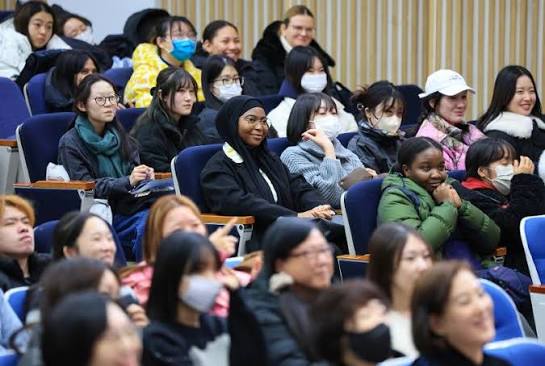
One of the main efforts is the Global Korea Scholarship (GKS), a fully funded scholarship designed to track, recruit, and foster future global leaders. It has a dual structure that offers help to high-achieving students and emerging global leaders (Zhang et al., 2025). International students are no longer viewed as temporary visitors but as potential skilled migrants representing an ideal talent pool that can help address labor shortages and contribute to innovation. However, retaining these graduates after they complete their studies remains a significant challenge. The transition from student to worker is not automatic. It involves going through a complicated visa process, meeting labour market expectations, and fulfilling institutional requirements (Brazzale, 2026). This makes it hard for students to settle permanently, even if they are encouraged to stay. The real question is not only about why students decide to come to South Korea but also wether they can build a life and a future there.
The main problem appears to be within South Korea’s immigration system. On the basis line, the South Korean visa system comprises 37 categories. After completing their studies, most international graduates turn to the D-10 (job-seeking) visa, which now allows up to three years to secure employment. However, getting promoted to the E-7 visa for skilled workers is still tough, as it requires exact major-to-career matching and high wage criteria. There are also two other options, the F-2-7 visa (points-based) and the F-5 visa (permanent residency), which are supposed to offer a way to stay long-term. However, in reality, these require a high level of Korean language skill, income, and education, making them hard to reach. Thus, despite around 90% of international graduates expressing their desire to stay after completing their studies, only 8.2% actually manage to get a job and stay (Feyissa & Park, 2026; Park, 2026).
Beyond immigration regulations, the employment system further complicates graduates’ transition into the workforce. During their studies, recipients of prestigious GKS may be recognized as valuable to South Korea, yet this privileged status often disappears upon graduation. Many international students report difficulties in accessing reliable information about job opportunities. Existing platforms often provide only limited or poorly translated information (Lee, 2026). Not to mention that in many cases, many corporate recruiters are not familiar with the process of obtaining a work visa, leading them to see international students as just foreign applicants rather than as skilled professionals. This makes them less likely to be hired, as companies prefer local candidates for lower risk (Nair, 2025; Lee, 2026). At the same time, university career services aren’t very helpful for international graduates because they often don’t have the expertise to support students through immigration and employment processes. Internship experiences can also be beneficial, but such opportunities are not equally available to all students, especially those outside of STEM fields (Park, 2026). As a result, graduates moving from being celebrated as “global talent” to being seen as outsiders in a labor market that continues to favor those who fit in culturally and linguistically.
These barriers show a bigger contradiction in South Korea’s strategy to attract international students. On one side, the government spends a lot of money to attract talented students through programs like GKS, seeing them as a possible solution to the country’s population decline and lack of workers. On the other side, strict visa rules, weak institutional support, and employers who do not want to hire foreign graduates make it hard for international students to stay long-term. In simple words, South Korea is quite good at bringing in global talent, but not as good at keeping or retaining them. This gap makes me question whether international students are truly seen as future members of Korean society, or if they are mainly treated as temporary resources whose value disappears once they leave university. Until Korea’s policies can better connect education with employment, the country will continue to attract talented students from around the world, but will keep having trouble retaining them there. Therefore, the future of international students in South Korea is still a story that is not finished yet, one filled with both opportunities and challenges.
Writer: Mudrika Sausan S Maruapey – 202410360110140
References
Brazzale, A. (2026, June 10th). Between Staying and Leaving: The Unfinished Journey of International Students in Korea. Seoul Institute of Global Affairs. https://seoulinstitute.com/between-staying-and-leaving-the-unfinished-journey-of-international-students-in-korea/
Feyyisa, I. F., & Park, H. J. (2026). Talent retention in the South Korea context: social support, cultural adaptation, and career opportunities discourage onward migration intentions of international students. Humanities & Social Sciences Communications. https://doi.org/10.1057/s41599-025-06463-7
Lee, S. K. (2026, January 2nd). South Korea wants foreign students, but does it want the graduates? Asia News Network. https://asianews.network/south-korea-wants-foreign-students-but-does-it-want-the-graduates/
Nair, A. (2025, August 27th). Korea welcomes international students but employability barriers remain. The Pie. https://thepienews.com/korea-welcomes-international-students-but-employability-barriers-remain/
Ok, L. S., & Boon, T. T. (2016, March 4th). CO16052 | South Korea’s Demographic Dilemma: Impact on Economy and Security. RSIS. https://rsis.edu.sg/rsis-publication/rsis/co16052-south-koreas-demographic-dilemma-impact-on-economy-and-security/
Pareliussen, J. (2025, March 24th). What we can learn from Korea’s demographic meltdown. CEPR. https://cepr.org/voxeu/columns/what-we-can-learn-koreas-demographic-meltdown
Park, L. S. (2026, June 10th). Diversity and Integration: Korea’s Multicultural Transition and the Professional Landscape for Global Talent. E-Korean Studies Basic Lecture Series at University of Muhammadiyah Malang, Indonesia.
Zhang, Y., Liu, T., & Ko, J. W. (2025). Internationalization Policies in South Korean Higher Education: Attracting and Managing International Students. Journal of Institutional Research South East Asia, 23(2), 49–70.