
Image source: Google
South Korea has established itself as an influential middle power on the global stage, particularly through its active role in the United Nations (UN) and the Group of Twenty (G20). As a country that has transitioned from an aid recipient to a development donor, South Korea leverages its position to bridge the gap between developed and developing nations, promoting global agendas such as green growth and development cooperation. The concept of a middle power is defined as a medium-sized country with the capability and willingness to engage in proactive, globally oriented diplomacy that serves both national interests and the global good. These nations promote a new vision that is acceptable both domestically and internationally, and contribute to its realization. South Korea can be defined as: the world’s 12th-largest economy (GDP of $1.7 trillion in 2023), possessing dual experience as both a developing and developed nation, and a commitment to multilateralism.
South Korea’s transformation began following the Korean War (1950–1953), during which the UN played a key role through the UN Command. Now a UN member since 1991, Korea positions itself as a “bridge power” between North and South and East and West, avoiding direct confrontation with major powers such as the US and China. As a G20 member since 1999 and host in 2010, Korea utilizes this forum for middle-power diplomacy, bridging the divide between the G7 and the BRICS. South Korea’s role in the United Nations demonstrated its leadership as a middle power through its service as a non-permanent member of the Security Council (UNSC) in 1996–1997 and 2013–2014. During that time, South Korea promoted international financial reform, nuclear non-proliferation, and peacekeeping operations (PKO). South Korea has deployed 880 personnel to 19 PKO missions since 1993, including in Lebanon and Darfur, despite being constrained by its pacifist constitution. South Korea is also active in the UN General Assembly, leading initiatives such as the Seoul Agenda for the MDGs (2010) and contributing to the Sustainable Development Goals (SDGs). As host of the 2012 Nuclear Security Summit, South Korea mobilized global commitments to nuclear security, involving 53 countries. This role reflects Korea’s “glue diplomacy”: connecting global issues through multilateral institutions, rather than military power. Additionally, Korea supports UNSC reform for fairer Asian representation, despite facing resistance from the P5.
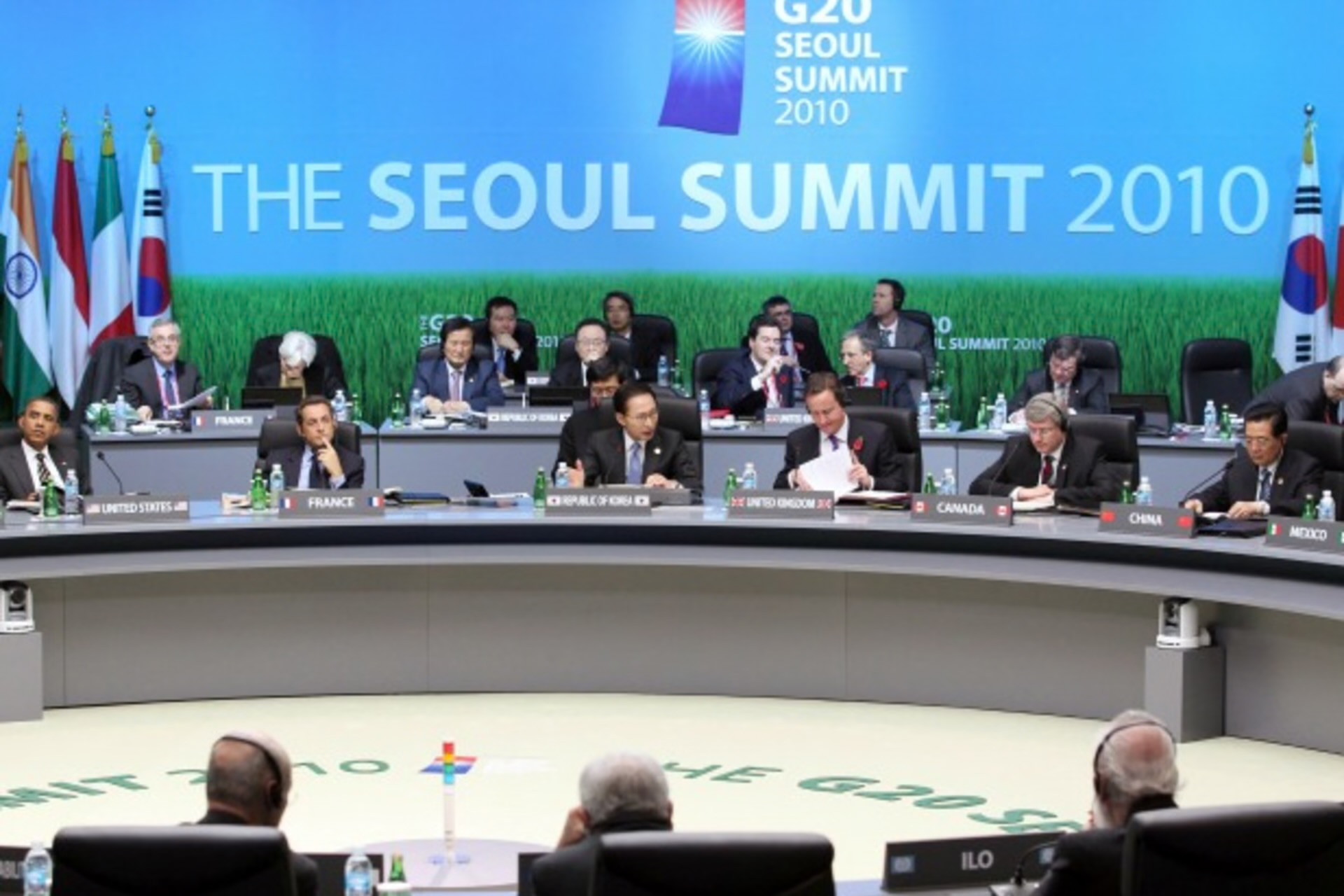
Korea’s role in the Group of Twenty (G20) has served as a key platform for its middle-power diplomacy, particularly as the host of the 2010 Seoul Summit, which was themed “Shared Growth Beyond Crisis.” Korea successfully forged a consensus on freezing trade protectionism, IMF reform (increasing emerging economies’ quotas by 6%), and establishing development as the G20’s sole priority with unanimous support. Korea’s “Inclusive Green Growth” initiative, through the Global Green Growth Institute (GGGI, 2012), promotes green technology in developing countries such as Indonesia and Ethiopia, with a $200 million contribution to the East Asia Climate Partnership. Korea facilitated dialogue among members, bridging the G7 and BRICS on issues such as IMF reform and anti-protectionism.
Through the 2011 Busan High-Level Forum on Aid Effectiveness, Korea established the “Global Development Partnership,” which involves new donors such as emerging economies and civil society. At subsequent G20 summits, Korea championed the digital agenda and cyber norms, including the 2013 Cyberspace Conference. This strategy demonstrates how a middle power like Korea can revitalize the momentum of cooperation amid factionalism. Contributions and Challenges as a Middle Power: South Korea contributes to global governance through MIKTA (Mexico-Indonesia-Korea-Turkey-Australia, 2013), an informal G20 forum for bridging diplomacy on issues such as climate, trade, and global health. South Korea’s ODA contributions reached 0.17% of GNI in 2023, focusing on Asia and Africa, thereby strengthening its legitimacy as a “responsible stakeholder.” However, challenges remain, such as reliance on the U.S. alliance for security against North Korea, which limits autonomy, while U.S.-China rivalry forces South Korea to navigate carefully. The COVID-19 pandemic and the war in Ukraine have underscored the need for middle-power leadership in global crises. Moving forward, South Korea can strengthen its role through agenda-setting at the UN—for example, on AI governance—and within the G20, while building networks with other middle powers. Thus, South Korea’s role in the UN and G20 demonstrates the potential of middle powers to shape global norms. Through creative diplomacy and institutional commitment, South Korea pursues not only national interests but also global stability.
Writer: Revana Zahra Koke Making – 202410360110134
Reference:
Council on Foreign Relations. (2013). Global Governance and Middle Powers: South Korea’s Role in the G20. https://www.cfr.org/report/global-governance-and-middle-powers-south-koreas-role-g20
Mo, J. (2016). “South Korea’s Middle Power Diplomacy”. International Politics, JSTOR. https://www.jstor.org/stable/26414059
Lee, K. S. (2016). “New Approach of South Korea’s Middle Power Diplomacy”. Global Politics Review. https://www.globalpoliticsreview.com/publications/2464-9929_v02_i02_p040.pdf