
Image source: Pinterest
Introduction
Rural development remains a crucial issue in many developing countries. Although big cities often get investment for modern buildings, transportation, and business facilities, rural communities may still face poverty, poor infrastructure, and limited access to public services. How can economic development improve the quality of life of people outside the big city? The Saemaul Undong movement in South Korea gives an interesting example of how the development of rural areas can be achieved through cooperation between the government and the local community. Introduced in 1970 under president Park Chung-hee, this movement aims to improve living conditions in the countryside through community participation and economic development (Asian Development Bank [ADB], 2012). The rationale behind selecting this subject lies in the fact that South Korea’s trajectory offers invaluable insights for emerging economies, such as Indonesia. In my opinion, development should not only focus on the modernization of the city, but also improve the quality of life of rural communities.
Main Problem: Rural Area Inequality and Uneven Development
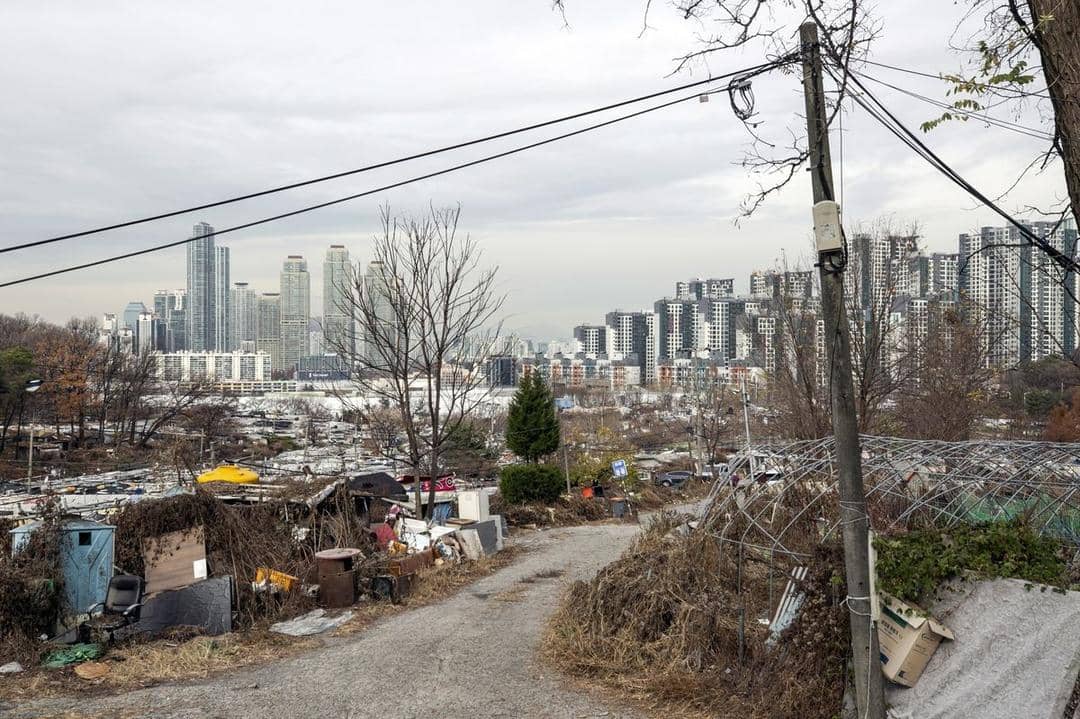
The central thesis of this essay examines the widening chasm between contemporary urban expansion and marginalized communities. The photo included in this essay shows a simple settlement with poor environmental conditions and limited infrastructure, while a modern multi-storey building is seen in the background. This scenario underscores the pervasive issue of uneven development, where economic expansion frequently fails to distribute its advantages equitably across all communities. Some communities still face the problem of inadequate housing, poor infrastructure, and limited economic opportunities, even though the surrounding area is getting more modern. This matter holds profound significance, as true development must not be gauged solely by the proliferation of modern edifices or the expansion of a nation’s economic output. Improving the quality of life of the community and access to basic facilities must also be measured. Consequently, narrowing the disparity between urban and rural regions should be established as a paramount objective for developing nations.
Saemaul Undong has been recognized as a prototype for rural advancement.
The rural development movement of Saemaul Undong was introduced by the South Korean government in 1970. The scheme was based on three principles: the principle of diligence, the principle of self-determination, and the principle of cooperation. The principles motivated individuals to cooperate in improving their villages instead of relying solely on government aid. The South Korean government provided materials, financial support, and infrastructure improvements, while local communities directly participated in development activities. Some of the projects carried out include repairing village roads, building bridges, repairing houses, developing irrigation systems, and increasing agricultural production. According to the Asian Development Bank (2012), Saemaul Undong is an important example of development that is encouraged by the community because it motivates local residents to be actively involved in improving their own quality of life. Park (2009) explained that the movement contributed to rural modernization and helped reduce the development gap between urban and rural areas in South Korea. In my opinion, one of the most important aspects of this program is that people are not only considered as recipients of government assistance. Instead, they become an active part of the development process. This approach encourages responsibility, cooperation, and a sense of belonging among the local community.
Analysis Through International Relations Concepts
Saemaul Undong can be understood through the concept of community-based development and good governance. Community-driven development emphasizes the importance of involving local communities in recognizing problems, making decisions, and implementing development programs. This method empowers individuals to articulate their desires and engage in the process of finding solutions that are compatible with their communities. Eom (2011) emphasized the importance of good governance in understanding the implementation of Saemaul Undong. Better decision-making, responsiveness, and accountability can be achieved by fostering cooperation between the government and local communities. This shows that successful development needs things other than financial assistance. Furthermore, successful implementation demands robust institutional frameworks, seamless coordination, and active engagement from the public. This case highlights the importance of international relations in enabling developing nations to learn from other nations’ development experiences through policy learning and international cooperation. South Korea’s experience can be an example for countries that want to improve their rural economies. Nevertheless, every nation is characterized by a unique configuration of political, economic, and social circumstances. Development plans should be tailored to local contexts and not cloned entirely.
Limitations and Lessons for Developing Countries
Saemaul Undong, while widely regarded as a successful rural development initiative, also has its drawbacks. The movement developed under the authoritarian rule of Park Chung-hee. During that time, the government had strong control over political and economic activities. Therefore, the program should not be seen as a perfect development model. Yang (2018) emphasized that community participation and local government are important factors in maintaining sustainable rural development. This means that development not only depends on government orders, but must also provide opportunities for people to make their own decisions. For Indonesia and other developing countries, there are several important lessons that can be learned from Saemaul Undong. Equal access to basic infrastructure, such as roads, clean water, electricity, education, and healthcare, should be provided by governments. Second, local communities should be involved in planning and implementing development programs because they understand their own problems and needs. The creation of sustainable economic opportunities requires governments to provide support to farmers, small businesses, and local industries. However, I believe that developing countries should apply the positive principles of Saemaul Undong without imitating the authoritarian political context of the program. Development must be inclusive, democratic and based on the real needs of local people.
My Opinion and Conclusion
In my view, the Saemaul Undong offers a critical insight: sustainable rural advancement is contingent on a synergistic partnership between state authorities and civil society. The presence of modern buildings and economic growth does not necessarily guarantee equal living conditions for all, as shown in the picture. A country can develop rapidly in a modern way, while some communities still face poverty and inadequate infrastructure. Consequently, development strategies must transcend the singular pursuit of economic expansion, prioritizing instead the mitigation of both social and economic disparities. Saemaul Undong is a prime example of rural development where government support, community participation and cooperation can lead to better living conditions. South Korea’s experience provides valuable lessons for developing countries such as Indonesia. Consequently, the deployment of this initiative necessitates adaptation to distinct national contexts, underpinned by a framework of democratic and transparent governance. In my opinion, the key to genuine development lies in ensuring that all communities have equal opportunities to improve their quality of life and participate in national progress.
Writer: Thahira Nayla Rahma Gayatri – 202510360110069
Reference
Eom, S.-J. (2011). The Rural Saemaul Undong Revisited from the Perspective of Good Governance.
The Saemaul Undong movement in the Republic of Korea : sharing knowledge on community-driven development. (2012). Asian Development Bank.
Yang, Y. (2018). Community participation for sustainable rural development: Revisiting South Korean rural modernization of the 1970s. Community Development Journal, 53(1), 61–77.