
Image source: Pinterest
Introduction
South Korea is one of the countries with the best education systems in the world. Its students consistently top the charts in various international assessments such as the Programme for International Student Assessment (PISA), indicating that the country has succeeded in establishing a high standard of education. The success is closely related to the South Korean culture that places education at the highest priority of life. For many families, academic success is not only a path to a good job, but also a symbol of prestige and social status.
From a young age, many students are expected to earn good grades, go to tutoring class (hagwon) and enter top universities, especially SKY Universities. In this competition, many students have to study most of the time, even late at night, to meet the expectations of their parents and social environment. Behind South Korea’s high educational achievements are accompanied by increased psychological pressure that is taking a toll on students’ mental health.
Therefore, the culture of academic competition in South Korea is an important issue to discuss as it is connected to the quality of education and the well-being of the younger generation. This essay will examine how the society’s prestige culture forces academic competition, creates the hagwon phenomenon, increases the pressure on students and contributes to the increasing levels of stress and depression and, in the most extreme cases, the risk of suicide.
The Culture
The culture of academic competition in South Korea has developed under the influence of social values that are deeply rooted in society. Education is seen as the key to social mobility, to a good job, to a better life for a family. In a culture still influenced by Confucian values, academic achievement is seen as a reflection of one’s discipline, hard work and success. Therefore, a child’s success is often seen as a family success, while academic failure is considered as a failure that will affect the family’s reputation in the community.
This mindset has built a very competitive culture from a young age. Many parents think that getting into a good university is the way to a better life. The SKY group of universities in South Korea (Seoul National University, Korea University and Yonsei University) are highly prestigious because their graduates are more likely to get jobs in major corporations and government agencies. This leads many parents and students to think that admission to an elite university is the way to a successful future. Therefore, a lot of students work very hard to get the best grades to be accepted into these universities.
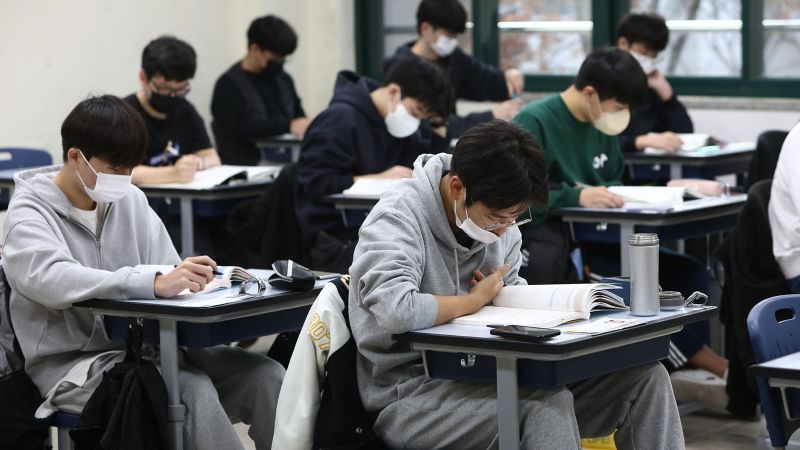
The competition has become a recurring cultural phenomenon. Most students are rushing to achieve the highest score and be accepted in elite universities. Many students believe that the College Scholastic Ability Test (CSAT), or Suneung, will decide their entire future. Students choose to spend most of their time studying, under pressure to get the best scores. For some families, a child’s acceptance into an elite university is also a source of pride and a symbol of social status. Therefore, the obsession with prestigious universities is one of the factors that strengthens the culture of academic competition in South Korea.
Hagwons and Long Study Hours
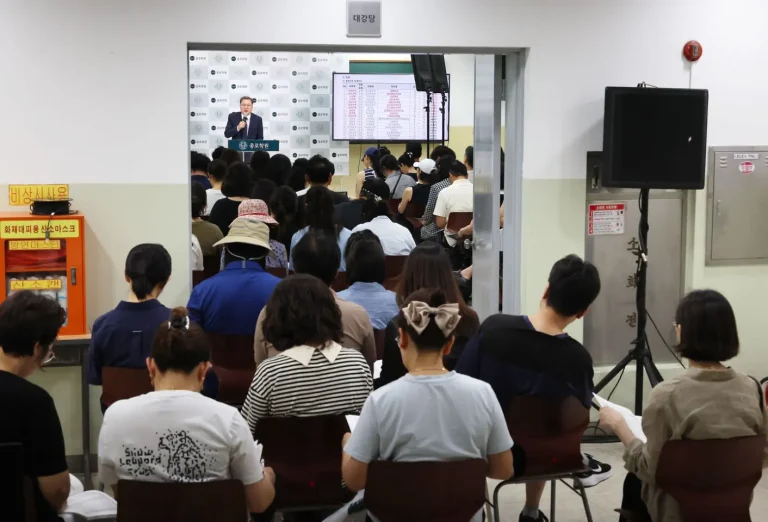
A strong culture of academic competition has driven the growth of hagwons, private tutoring centers that have become routine in the lives of many South Korean students. Although students are in school all day, most of them still attend extra classes in the afternoons and evenings at hagwons. The goal is to raise academic achievement and to prepare for the CSAT, or Suneung, a college entrance exam considered crucial to students’ futures.
The hagwon phenomenon suggests that academic success is no longer the result of formal education in school. Many parents are prepared to pay huge amounts of money to get their children supplementary education and a better chance of being accepted into top universities. In fact, some families begin sending their children to hagwons from a very young age because they worry that their children will lag behind their classmates. This situation shows that academic competition is not only felt by students but also places pressure on parents who feel they must continue to invest in their children’s education.
However, the existence of hagwons has ended up in longer study hours for students. Many students come home late at night after attending school and tutoring sessions. As a result, they have limited time left for rest, interaction with family and non-academic activities. While the hagwon culture is thought to improve academic performance, this condition also leads to questions of the balance between academic achievement and student well-being.
Academic Pressure and Its Impact
Students face more pressure as a result of the culture of academic competitiveness becoming more competitive. This pressure originates not only from the school but also from society and parents, who hold academic achievement in high regard as an indicator of future success. Because of this, students accomplishments are frequently considered as indicators of family status, therefore getting low grades or being rejected for acceptance to a top university is viewed as a failure.
The constant academic pressure can be risky for student mental health. Many studies have shown that many students in South Korea are anxious, exhausted and even depressed due to the high demands of studies. The Korea Youth Risk Behavior Survey (KYRBS) found that nearly 25% of students reported experiencing signs of depression in the past year. Many students experience physical and emotional exhaustion due to long study hours, intense competition and fear of failure. Furthermore, suicide is the most common reason of death among South Korean teenagers. Suicide is a problem that is affected by various factors, but the high level of pressure in the education system cannot be overlooked as a contributing factor to the deterioration of students mental health.
Conclusion
The culture of academic competition has been deep rooted in South Korea’s education system. The pressure to receive the best results, be accepted to the best universities and meet the expectations of the family has created a highly competitive learning environment. This culture has managed to elevate the quality of education in South Korea to a level where it is considered as one of the best in the world. However, heavy academic pressure has also brought serious consequences on students mental health including increased stress, depression and even the risk of suicide.
The effectiveness of an educational system should not be based on high academic achievement by itself but also the system’s ability to support a healthy learning environment that encourages students overall growth. Education is indeed important as a foundation for the future but these achievements should not be at the cost of the mental health or quality of life of the younger generation. Therefore, it is necessary to maintain a balance between academic achievement and student well-being so that the education system can produce a generation that is not only intellectually intelligent but also psychologically healthy.
Writer: ALEXANDRA MAHADEWI CINTA MAKARIM – 202410360110100
Source:
Channel NewsAsia. (2023, April 27). Commentary: Academic competition is causing misery to South Korean children and parents alike. https://www.channelnewsasia.com/commentary/south-korea-children-academic-pressure-mental-health-tuition-3409576
Chung, J.-H., & Park, Y.-S. (2024). A study on the relationship between academic stress and mental health among high school students in South Korea. Research and Advances in Education, 3(1), 54–65. https://www.paradigmpress.org/rae/article/view/984
Institute for Security and Development Policy. (2023). Is academic pressure & declining mental health the new normal for South Korean youth? https://www.isdp.eu/is-academic-pressure-declining-mental-health-the-new-normal-for-south-korean-youth/
Jung, M.-h. (2024, May 29). Suicide remains No. 1 cause of death among young Koreans. The Korea Times. https://www.koreatimes.co.kr/southkorea/society/20240529/suicide-remains-no-1-cause-of-death-among-young-koreans
OECD. (2023). PISA 2022 results (Volume I and II) – Country notes: Korea. https://www.oecd.org/en/publications/pisa-2022-results-volume-i-and-ii-country-notes_ed6fbcc5-en/korea_4e0cc43a-en.html
Taylor, A. (2024). The impact of Hagwon (private tutoring centers) on high school students’ academic performance in South Korea. Journal of Advanced Research in Education, 3(4), 1–10. https://www.pioneerpublisher.com/jare/article/view/889
Taylor, A. (2024). The impact of Hagwon (private tutoring centers) on high school students’ academic performance in South Korea. Journal of Advanced Research in Education, 3(4), 1–10. https://www.pioneerpublisher.com/jare/article/view/889
The Hankyoreh. (2009, April 5). ‘첫 단추’ 중1 중간고사부모 조바심은 금물 [The first button: Middle school first-year midterms Parents impatience is forbidden]. https://www.hani.co.kr/arti/society/schooling/348060.html
The Korea Times. (2025, June 25). Teen suicides keep rising as school stress takes toll. https://www.koreatimes.co.kr/southkorea/society/20250625/teen-suicides-keep-rising-as-school-stress-takes-toll
TIME. (2023, June 28). Why South Korea’s latest cram school crackdown is doomed to fail. https://time.com/6292773/south-korea-crackdown-hagwons-cram-schools-competition/
TIME. (2024, April 18). Exclusive: How insufficient data and funding hamper suicide prevention in South Korea. https://time.com/6982596/south-korea-suicide-prevention-centers-data-funding-insufficient/